Top stories
![Pakistan Cyber Force [Official]](http://feeds.feedburner.com/PakistanCyberForce.2.gif)

Showing posts with label Pakistan Army. Show all posts
Showing posts with label Pakistan Army. Show all posts
Monday, January 19, 2015


Friday, May 23, 2014
"Time for Talks is Over!", Gen. Raheel tells Nawaz Sharif

- Subscribe to PCF Networked Blog Daily Updates
- Subscribe to our Twitter / Google / Yahoo Daily Updates

Sharif came to power a year ago promising to find a peaceful settlement with the Islamist militant group, but as round after round of talks failed, the powerful armed forces favoured a military solution.
Their patience finally ran out and, late on Tuesday afternoon, during a tense meeting, the army effectively declared it would override a crucial plank of the government’s strategy and take matters into its own hands.
“The army chief and other military officers in the room were clear on the military’s policy: the last man, the last bullet,” a government insider with first-hand knowledge of the meeting told a foreign news agency.
Asked to sum up the message General Raheel Sharif wanted to convey at the gathering, he added: “The time for talk is over.”
The next day, Pakistani forces launched rare air strikes against militants holed up in the remote, lawless tribal belt near the Afghan border. It is not clear whether Sharif authorized the operation.
On Thursday, they backed that up with the first major ground offensive against the Taliban there, undermining Sharif’s year-long attempt to end a bloody insurgency across his country through peaceful means.
Disagreement over the militant threat is the latest row to flare up between the government and military, and relations between the two branches of power are at their lowest ebb for years, according to government officials.
The government did say talks with the Taliban would go on.
“We will talk with those who are ready for it and the (military) operation is being launched against those who are not ready to come to the negotiating table,” spokesman Pervez Rashid told local media on Thursday.
But the operations put the military, which has a long record of intervening in civilian rule through plots and coups, firmly back at the centre of Pakistan’s security policy.
The balance of power is shifting at a time when foreign troops are preparing to withdraw from Afghanistan, and arch-rival India has just elected a Hindu nationalist leader promising to be more assertive on the international stage.
“This is the clearest signal yet that the army will dictate its terms now,” a member of Sharif’s cabinet said.
TALIBAN ON THE OFFENSIVE
The Pakistani Taliban, as distinct from the Afghan Taliban which is actively targeting NATO forces in Afghanistan, is believed to be behind attacks on Pakistani soldiers and civilians that have killed thousands in recent years.
The Pakistan army has distinguished between “good” Taliban like the feared Haqqani network – who do not attack Pakistani security forces but fight in Afghanistan – and “bad” Taliban, indigenous Pakistani militants who are seeking to create an Islamic state.
While Pakistan’s military wants to go after the “bad” Taliban, it has, despite pressure from Washington, largely avoided taking on groups who launch attacks against coalition forces in Afghanistan from Pakistan’s North Waziristan region.
Prompting the latest intervention, the Pakistani Taliban have become increasingly bold, striking the army in tribal areas including a recent battle in which an army major died. Earlier this month, nine soldiers were killed in an explosion near the Afghan border.
“We will avenge the blood of every last soldier. Talks or no talks, the army will retaliate,” said one military official, who, like most others interviewed for this article, spoke on condition of anonymity due to the sensitivity of the subject.
The army has ruled Pakistan for more than half of its history. Sharif himself was toppled by the army in 1999 during his previous tenure as prime minister.
But, humiliated after a secret 2011 U.S. raid that killed Osama bin Laden on Pakistani soil, the army stood back from politics and supported last year’s first democratic transition of power which brought Sharif back to office.
Sharif manoeuvred carefully, hand picking a new army chief and trying to forge a partnership with the military in the early days of his tenure, but the overtures had little lasting impact.
TRADE, DIPLOMACY
There are other signs of civil-military discord.
Sharif came to power promising to rebuild relations with India, but has been under pressure to toughen his stance from hardliners at home, particularly within the army.
The nuclear-armed neighbours have fought three wars since independence from Britain in 1947, two of them over the still-disputed Himalayan territory of Kashmir.
Sharif’s policies towards India have been heavily scrutinized; some in the army justify its hefty budget by pointing to – and, critics say, playing up – the potential threat from India.
And despite signs the military has become more amenable to overtures from its old foe than in the past, a trade deal pushed by the prime minister and aimed at improving ties with India was cancelled at the last minute after pressure from the army, top government officials said.
Sharif now faces a dilemma over whether to accept an invitation by Indian Prime Minister-designate Narendra Modi to attend his inauguration next week.
The army is also bitter about the trial of former military ruler Pervez Musharraf, who ousted Sharif from power in 1999 and was arrested after he returned to Pakistan to take part in last year’s election.
Ties with Afghanistan have never been easy, but some officials believe the army wants to torpedo the government’s relationship with a future Kabul administration, risking deterioration in regional security as NATO troops prepare to leave this year.
Generals have jealously guarded the right to dictate policy on Afghanistan, seeing friendly guerrilla groups as “assets” to blunt the influence of India there.
TENSIONS COME TO SURFACE
Though simmering under the surface, tensions between the government and the army spilled into the open last month when a popular journalist was shot by unknown gunmen, and his channel, Geo News, blamed the army’s powerful spy agency, the Directorate of Inter-Services Intelligence (ISI).
Public criticism of the shadowy ISI is almost unheard of in Pakistan. In a rare public response, the army demanded that Geo News, the country’s most-watched news channel, be shut down.
The government’s media regulator has since resisted the army’s demands to cancel the channel’s license, which the military sees as a direct sign of defiance.
“Everyone was looking out to see how the government would treat the army in this crisis — as a friend or foe?” said a senior military official. “But the government allowed this to become a free-for-all, army-hunting season.”
For Sharif, buckling under military pressure is a major risk. “This is not about one TV channel but about freedom of expression and about living in a democracy,” Rashid said. “We should live and let live.”
But despite putting on a brave front, officials say the government is feeling under siege.
“Never in the last year has the government felt weaker or more vulnerable,” one of Sharif’s key economic advisers said. “Now every time we have to take a major decision, on India, on Afghanistan, we will have to think ‘How will the army react?’”
A serving general said the army chief would always pick the “institution over the constitution if push comes to shove,” adding: “As a society and a state, we have to avoid a context in which the army is pushed to do something it doesn’t want to.”
(Pakistan Today)
Pakistan Cyber ForceTuesday, March 18, 2014
India, Afghanistan to Supply Chemical Weapons, SAMs to TTP Terrorists - Report

Sunday, July 28, 2013



Monday, June 17, 2013
Pakistan crisis - Detailed fact sheet
- Subscribe to PCF Networked Blog Daily Updates
- Subscribe to our Twitter / Google / Yahoo Daily Updates
This is what happened in Quetta and Ziarat yesterday. A detailed fact sheet and analysis. This analysis is written by a senior retired army officer.
*********************
 The destruction of Quaid's Residency at Ziarat was still being told by TV anchors, on 15 June 2013, when at about 1 p.m. a bomb was exploded in a bus full of girls about to disembark in the Women's University. The bus used to pickup mostly Shia Hazara girls from Alamdar Road, which is a Shia Hazara locality. Even before Lashar-a-Jhangvi claimed responsibilty, people in Quetta had no doubt who was behind the explosion.
The wounded were rushed to the adjacent Bolan Medical College. As the wounded and helpers were being crowded in Emergency Room, a man walked in and blew himself up killing some more. Possibly 3-4 criminals walked in and took 34 men and women as hostages, some criminals were already on the roof top and started shooting at the crowd. Police, FC and Civil Administration rushed to control the situation. After nearly 6 hours, three more criminals were killed, one suspect arrested and with blood splattered everywhere, BMC was declared clear of criminals. Sun was about to set.
The death toll; 29. 14 young girls died, 19 are badly burnt and in hospitals. Many deceased girls were indeed, non-Shias, one was a Christian. Four soldiers of FC, including a Captain died trying to save lives and rescue hostages. Quetta's Deputy Commisioner, Assistant Deputy Commision, one Lady Doctor, four nurses, two policemen and 6 pedestrians were killed. Several more, including another Assistant Commisioner were injured. The Civil Administration, FC and Police bravely fought and stood against the criminals who had taken advantageous positions and had the benefit of blending into the peaceful crowed.
Innocent, very young and dutiful people died futilely because of sectarion-fanatics.The deaths were mourned by all Quetta, and surely by all Pakistanis and even foreigners abroad. The people of Quetta forgot about the National Heritages' loss at Ziarat and Women University/BMC carnage became the talk of the town.
Oh yes, the people of Ziarat are still mourning the destruction of Quaid's Residency. Ziarat remains shut for the second day. The few thousand people are still sitting on road, not knowing to whom to turn to. Some were seen openly crying when they saw the Residency. The grief is akin to a dear ones death.
However, people of Quetta were blaming many more than the sectarian fanatics who had actually carried out the killings. These fanatics had even disregarded ethics of war by ancient pagans who would not kill children and women. But everyone thought, these were merely the pawns, the responsibility lay at many more persons.
Who is responsible for this carnage ??
Domestic Players
1. Zardari, Yousaf Gilani and Aslam Raisani. The 5 years' ignominious tenure of PPP government is responsible for totally loosing the writ of government, especially in Balochistan. Target killers, kidnappers, dacoits, vehicle hijackers and land grabbers were regularly let off on calls from the then CM Aslam Raisani and his brother Siraj and 55 some ministers. When the then PM Yousaf Gilani was asked while visiting Quetta for the poor state of law and order, he had replied that it was a provincial subject and concerned the CM. Zardari allowed Gilani and Aslam to sit like Neros while Rome, or in this case, Baluchistan was aflame. Punjabi doctors, teachers, advocates, businessmen, tailors, barbers, workers were systematically murdered in ethnic cleansing. Dutiful police officers were killed. Criminals were hired as policemen and officers. What is happening in Baluchistan today, is the crop sowed by these three criminals, Zardari, Gilani and Aslam. Then there were many accomplishes, like the hibernating Governor Magsi, the JUI which looked the other way, saw no evil and never objected to the rape of the province as long as Fazalul Rehman got his millions through his ministers..
2. CJ Iftikhar and his Coterie of Judges. Balochistan CJ Faiz Essa ordered the Police and courts to register FIR against the 'murder' of Akbar Bugti, who actually had committed suicide. Thus started a witch hunt against law-enforcers. Given the attitude of the judges, which law enforcer is safe from prosecution? All terrorists were let off for 'want of evidence'. The modern insurgency/extremists' crimes, sponsored by Pakistan's foreign enemies were being tried by 1865's Anglo-Sexon law. CJ ran a masquerade of visiting Quetta, asking no one else but IGFC to provide him security. In court he raved and ranted against the same FC and tried to humiliate the General. His contempt for Armed Forces was so very evident and his treatment of criminals so benevolent. A look at the under 16% conviction rate in Pakistan, and much lower in Baluchistan clearly shows who is abetting the extremists and criminals.
3. And last, the Army. The patience of Army may be lauded for letting the Democracy progress while exacting 'Revenge' from this country, but Army's inaction cannot. It has been detrimental to the national security in its broadest sense. Army has sat motionless listening to insults, false accusations, seeing the ethnic cleansing in Baluchistan go on unchecked, looting of the country's wealth, systematic destruction of Railways, PIA, corporations and looking the other way when presence of 'ferrari camps', i.e training camps of militants, sectarian criminals and insurgents were reported over and over again, even in media. It allowed the anti-Pakistan journalists and anchormen and women to systematically demoralize the nation by ridiculing and humiliating Army, encouraging and promoting insurgents by inviting them to demand breakup of Pakistan on TV channels. Mir Jaffars and Mir Sadiqs of our times are given prime time coverage on TV channels with the likes of Hamid Mir and Nusrat trying to be more of Pakistan's enemies than India and US.
4. And finally NS. People question, why are there no sectarian killings in Punjab? Why is insurgency, militancy and sectarian killings rampant only in KPK, Sindh and Baluchistan? Does NS want to further weaken these three provinces? Punjab is breeding sectarian militants and has allowed them safe havens. This perception is growing. It may be ignored only to the detriment of National cohesion and security.
There is a crying need to address these perceptions of the people in Quetta. The CJ and his judges who are busy trying to exact 'revenge' from retired Generals must become at least cognizant of history's judgement if they find the Day of Judgement very distant.
Zardari, Gilani, Aslam, and many more have already become history. They regularly receive all types of curses, abuses and condemnations. Their accountability in this very world has already started.
Those who can still make a difference, must do before they too are dumped into the dustbin of history.
This article has been written by a retired senior Army officer on the condition of anonymity.
Pakistan Cyber Force
Wednesday, April 10, 2013
Pakistan successfully launches Hatf IV Shaheen-1
- Subscribe to PCF Networked Blog Daily Updates
- Subscribe to our Twitter / Google / Yahoo Daily Updates
Today’s launch, whose impact point was at sea, was witnessed by Director General Strategic Plans Division Lieutenant General (Retired) Khalid Ahmed Kidwai, Chairman NESCOM Mr Muhammad Irfan Burney and other senior military officers, scientists and engineers.

Director General Strategic Plans Division Lieutenant General (Retired) Khalid Ahmed Kidwai congratulated all scientists and engineers on the successful launch. He said that the improved version of Shaheen 1 has consolidated and strengthened Pakistan’s deterrence abilities manifold. He appreciated the efforts of all personnel for their dedication and professionalism.
(ISPR)
Pakistan Cyber Force
Wednesday, November 28, 2012
Pakistan successfully test-fires MRBM Hatf V (Ghauri)
- Subscribe to PCF Networked Blog Daily Updates
- Subscribe to our Twitter / Google / Yahoo Daily Updates
RAWALPINDI: Pakistan today successfully conducted the training launch of Medium Range Ballistic Missile (MRBM) Hatf V (Ghauri).The launch was conducted by a Strategic Missile Group of the Army Strategic Force Command on the culmination of a field training exercise that was aimed at testing the operational readiness of the Army Strategic Force Command. Ghauri ballistic missile is a liquid fuel missile which can carry both conventional and nuclear warheads over a distance of 1300 kms.The test monitoring of the launch was conducted at the National Command Centre through the medium of National Command Authority s fully automated Strategic Command and Control Support System (SCCSS).
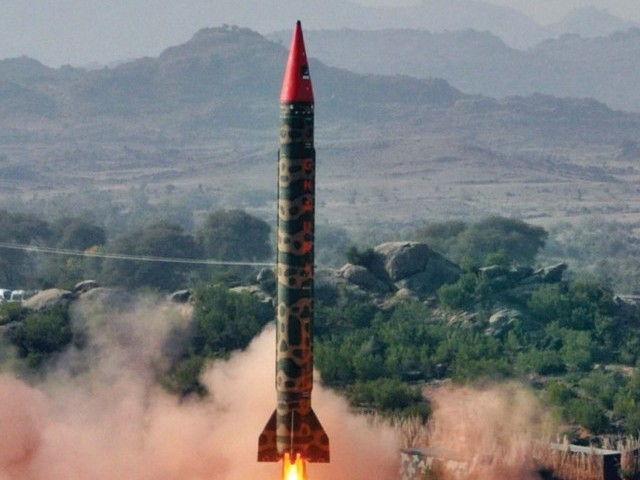
It may be recalled that the SCCSS enables robust Command and Control capability of all strategic assets with round the clock situational awareness in a digitized network centric environment to decision makers at the National Command Centre (NCC). The test consolidates and strengthens Pakistan s deterrence capability, and national security.The President and Prime Minister congratulated all ranks of the Army Strategic Force Command on the excellent standard achieved during training which was reflected in the proficient handling of the weapon system in the field and the accuracy of the training launch

It may be recalled that the SCCSS enables robust Command and Control capability of all strategic assets with round the clock situational awareness in a digitized network centric environment to decision makers at the National Command Centre (NCC). The test consolidates and strengthens Pakistan s deterrence capability, and national security.The President and Prime Minister congratulated all ranks of the Army Strategic Force Command on the excellent standard achieved during training which was reflected in the proficient handling of the weapon system in the field and the accuracy of the training launch
Pakistan Cyber Force
Monday, November 12, 2012
Sympathy for Sandy among Pakistan's forgotten flood victims
- Subscribe to PCF Networked Blog Daily Updates
- Subscribe to our Twitter / Google / Yahoo Daily Updates
While the United States recovers from superstorm Sandy, away from the glare of the international media, five million Pakistanis are struggling to get by in the country's third successive year of massive floods. Two years after the worst floods in Pakistan's history captured the world's attention, this summer's monsoon rains once again inundated huge areas of the Indus Valley, with rural parts of Sindh province the worst hit. At the floods' peak in September, more than quarter of a million were in relief camps across the country. Many have now gone home, but in Sindh, 160,000 remain homeless.

Abdur Razzaq Mirali is among them. As hundreds of thousands of Americans wait for their electricity to come back on after Sandy, 55-year-old Mirali's ambitions are rather more modest. "Look, this is my house," he told AFP, pointing to a small mudbrick building half-submerged in filthy brown water. "I am waiting here for the water to recede so we can start our normal life again."
Mirali and his family have waited two months so far and still their village -- also called Mirali -- swims knee-deep in foul-smelling water polluted with human and animal waste, where snakes dart around.
The 80 families of the tiny hamlet in Sindh's Jacobabad district, around 500 kilometres (300 miles) north of the metropolis of Karachi, shelter in makeshift shacks on a patch of higher ground overlooking their waterlogged homes and fields. The world has paid scant attention to Pakistan's flood victims this year. No blanket media coverage, no benefit concerts by pop stars, just foreign aid organisations doing their best on the ground with limited resources. But among Mirali's flood victims there is no resentment of the global attention lavished on America's eastern seaboard, only gratitude for US help and a feeling of solidarity not always present in a country where anti-American feeling often runs high.
"We should not be jealous of them. They are very generous people who have always helped us. They deserve the attention now when they are in duress," said farmer Ghulam Ali, 26. "What we just want is to be helped to restore our normal life." In this remote rural area, foreigners are a rare sight and so all white aid workers are regarded as "Americans". "It is really amazing to see these Americans are helping us here despite having a much worse storm in their own country," said Hashim Mugheri, dressed in a worn-out shirt and loincloth and sporting a grey walrus moustache. "The Americans are helping us here and some of our people are still abusing and hating them," he said.
National Disaster Management Authority says five million people have been affected by this year's floods, three million of them in Sindh, and more than 1.1 million acres (450,000 hectares) of crops destroyed. With so much farmland under water, there are fears for food supplies. The World Food Programme (WFP) is working to supply 1.2 million people with rations for and hopes to extend the scheme for 700,000 of the most vulnerable for a further two months. "This three-month intervention will ensure continued unconditional food support as lands are inundated and crop planting remains unlikely in many areas," said Nicole Carn, WFP Emergency Response Coordinator in the region. "While floodwater is slowly receding in many areas, food insecurity remains a major concern in the affected areas." The NDMA says it has handed out more than 230,000 37-kg ration packs with rice, flour, lentils and other essentials -- more than 50,000 of them in Jacobabad district.
But food problems look set to continue. The floods mean the "rabi" crop -- planted in the winter for a spring harvest -- will be disrupted, threatening supplies next year. NGOs are warning that more help is needed, and quickly, and Wahab Pandhrani, who heads local aid group Pirbhat said Islamabad had let its people down by not appealing for foreign assistance. "The government committed a huge blunder by taking the disaster too lightly," Pandhrani said.
"There is still time to launch an appeal for international help as we could face a huge problem in food security and malnutrition shortly." Stacey Winston of the UN Office for the Coordination of Humanitarian Affairs (UNOCHA) said nearly $170 million was needed to support families for up to six months with food, water, shelter and other necessities, particularly with winter approaching.
Pakistan Cyber Force
Sunday, October 28, 2012
The life of a soldier - Tribute
- Subscribe to PCF Networked Blog Daily Updates
- Subscribe to our Twitter / Google / Yahoo Daily Updates
 Standing in the soul-shivering cold with a determination to serve the homeland and gaurd it against any physical aggression, a soldier reminds his mother advising him in his early youth not to let down the green flag ever in his life. He feels the warmth of the words of his mother in that hard cold weather which is his only motivation against the fears popping up in his heart. He knows that his fiancee is waiting for him back in his village to be married to him but the pushing force behind his ultimate determination is his urge of getting the triumph of dying for his motherland for he knows that his life is worthless in front of the great duty he has been handed over.
 The soldier feels the pride of lifting the whole nation on his tough shoulders as his chest is the first barrier between his enemies and and his nation. He doesn't care whether his chest will be decorated with medals after his soul departs nor does he want any valuable reward. His only gain is his satisfaction of conscience in this battle of life and death as no one sheds his life for few medals and wordly rewards.
The mother of a soldier sheds tears for her son every night and prays to Lord for his safety but she never prays for her son to be called back from the battlefield, she never complains, she never desires. She knows the worth of the mission that her son has been assigned and after shedding tears she shuts her eyes gently with pride. She thanks the Almighty for choosing her son for this sacred job.
The soldier's younger sister remembers the days when they were little and used to play together in the village's playground. She recalls the golden moments spent with her brother looking at the sky full of stars and wishes that her brother can be with her right now, but suddenly coming out of the cloud of memories she realizes that her brother is in the severity of weather gaurding millions of sisters like her so they can dream of a sparkling future. Her sadness turns into pride and taking a long breath, she thanks the Almighty for assigning this noble duty to her brother.
A soldier never regrets his decision to serve the land. He beats the severe conditions with his remarkable power of endurance for he is persistent to defend the land where he grew up. His friends are in the quest of building their professional career but he knows that he and his comrades on the battlefield are the chosen and lucky ones to be there as very few qualify the merit of the position he holds. Not many dream of having his position, because everyone doesn't know the worth of being a soldiers, the saviour of the nation.
The soldier sheds tears realizing that some of his countrymen play in the hands of his enemies and malign his noble position and cause. But his heart gains the strength knowing that majority of his nation is backing him. He recalls the love and affection he recieved back in his village from his relatives to shun the bad thoughts and hopes that his misled countrymen will also enchant slogans in his favor once they are guided to the right path. The sun was rising and the soldier was feeling happy when he heard the call of his mate who was next on duty. The soldier offers the morning prayers and goes into his bunker for a well-deserved sleeping hoping that his sleep will not be spoiled as it was continously spoiled for the last one week due to heavy clashes with enemies.
We are soldiers, Don't love us as we die young!
Pakistan Army Zindabad!
Follow the author on twitter here
Pakistan Cyber Force
Wednesday, October 10, 2012
Malala Injured–Shame on Foreign Sponsored TTP
- Subscribe to PCF Networked Blog Daily Updates
- Subscribe to our Twitter / Google / Yahoo Daily Updates
The National Peace Award winner, Malala Yousafzai, who was attacked in Swat, is currently under treatment in CMH Peshawar. Later, Malala were taken to Peshawar via helicopter and admitted in CMH Peshawar. It is important to mention that Malala had been receiving threats to her life, after which she was provided with a special car and unarmed security personnel. According to the electronic media reports, Indian sponsored Tehreek-e-Taliban (TTP) has accepted the responsibilities.
 |
| Pakistan's Chief of Army Staff General Ashfaq Pervez Kayani is in Peshawar for Malala Yusufzai. His visit speaks volumes on Pakistan Army and Malala's strong relations especially after Operation Rah-e-raast in Swat Valley. |
Malala Yousaf zai is one of the best-known schoolgirls in the country. Young as she is, she has dared to do what many others do not – publicly criticise the Taliban. According to BBC, Malala’s confident, articulate campaign for girls’ education has won her admirers – and recognition – at home and abroad. She has appeared on national and international television, and spoken of her dream of a future Pakistan where education would prevail. Even by the standards of blood-soaked Pakistan, there has been shock at the shooting. It has been condemned by Pakistan’s Prime Minister, Raja Pervez Ashraf, who sent a helicopter to transfer Malala to hospital in Peshawar. The head of Pakistan’s Independent Human Rights Commission, Zohra Yusuf, said “this tragic attack on this courageous child” sends a very disturbing message to all those working for women and girls.
All segments of society are praying for her health and are condemning activists, those desire to enforce their own agenda against the will of general public. Notably, the said terrorism occurred just after the long march of Imran Khan.
There could be the possibility that firing on courageous Malala has been carried out by Afghanistan sponsored anti Pakistan Taliban. CIA and her allied agencies quite notorious in using dirty tricks for completion of their own designed agenda against Pakistan and in other countries. Notably, PTI Chief Imran Khan through a peaceful conduct of “Long March” in tribal belt of Waziristan gave positive message that people of Pakistan demand that their sovereignty should be respected and killing of innocent people through drones be stopped. Thus, targeting Malala through anti Pakistan Taliban could be one of the episodes of jeopardizing local peace efforts and pressurizing Pakistan to carry out operation in North Waziristan. In this connection, there are reports that for implementation of hidden aims, especially, RAW has hired the services of many so called Muslims of Northern Afghanistan which are known as "Khawarij". Posing themselves as militants, they have joined the ranks and files of the outlawed Tehreek-e-Taliban Pakistan (TTP) and other extremist outfits.
Earlier, US Secretary of State Hillary Clinton during her visit of Islamabad in 2011, agreed with Pakistan’s stance, saying, “Now US is realising that launching new military operation in North Waziristan does not suit Pakistan’s situation.” Replying to a question that the Inter-Services Intelligence (ISI) was involved an assault on the US embassy in Kabul on September 13, 2011, she categorically pointed out, “We have no evidence.” She also requested for Pakistan’s help to “encourage Taliban to enter negotiations in good faith” including the Haqqani militants. Pakistan’s Interior Minister Rehman Malik and top civil and military officials have repeatedly disclosed that training camps are presence in Afghanistan, and supply of arms and ammunition to the Baloch separatists and Pakistani Taliban keeps on going by the external elements as part of a conspiracy against Pakistan.
The internal dynamics of Pakistan, however, dictate that a detailed and comprehensive strategy be formulated to cleanse areas infected by terrorism through shrewd corrective measures and judicious action with least collateral damage. Such strategy has to be indigenous one with blend of native society
We must salute to courageous daughter of Pakistan “Malala Yousaf Zai” and pray for her health, safety and unite ourselves for continuation of her innocent but beautiful dreams regarding girls’ education and rooting out of terrorism from our motherland.
By Zaheer ul Hassan
The writer can be approached through zameer36@gmail.com
Pakistan Cyber Force
Tuesday, September 25, 2012
Army continues Flood Relief Operations
- Subscribe to PCF Networked Blog Daily Updates
- Subscribe to our Twitter / Google / Yahoo Daily Updates

Boats of Army engineers are busy helping the flood-affectees in moving to safer areas. More than 8,000 affectees have been rescued so far, it added.Helicopters are being used extensively to deliver ration to marooned people.
Pakistan Cyber Force
Friday, August 24, 2012
“No Operation in NWA; They are Patriots” - Pakistan Army
- Subscribe to PCF Networked Blog Daily Updates
- Subscribe to our Twitter / Google / Yahoo Daily Updates

(APA)
Pakistan Cyber ForceTuesday, August 21, 2012
Valliant Security Forces Foiled Kamra Assault
- Subscribe to PCF Networked Blog Daily Updates
- Subscribe to our Twitter / Google / Yahoo Daily Updates

In these terms, when nine militants disguised in security forces’ uniform, equipped with latest guns, and rocket launchers attacked Pakistan Air Force Base at Kamra on August 16, the valiant personnel of Pakistan Air Force and Special Service Group (SSG) of Commandoes of Pak Army foiled the assault by killing all the terrorists. Only one soldier was martyred.
According to PAF sources, fierce gun-battle took place between the security forces and blasts were also heard. It shows that both the warring parties were well-equipped with arms and weapons. While, on the one side, terrorists were also mentally prepared to die in order to complete their mission, on the other side, besides their professional training, Air force soldiers were also ready to die so as to castigate the terror-assault. In this situation, PAF soldiers defeated the militants due to their courage and spirit of sacrifice.
The fearlessness of the Air Force personnel could be judged from the fact that the Base Commander Air Commodore Azam Khan, who led the operation from the front, also sustained bullet injuries. Although Pakistan Air force soldiers were already on the state of high alert after receiving the related-information, but the coward insurgents tried to attack in the wee hours of the night. The security arrangements, consisting of four tiers have been able, not only to stop the terrorists on the 2nd tier and also killed them.
Notably, terrorists mostly succeed in their attempts as past experience indicates in Pakistan and other volatile countries. Let us take the example of Afghanistan where in more than ten years, well-trained NATO forces, equipped with latest weaponry have failed in stopping sudden terror attacks on their bases and military installations. In fact, they have been demoralised as they lack the passion of sacrificing their own lives and fighting spirit. Besides, militants are at advantage in this new style war because of their surprise and sudden strikes. And it is a war in which offence knows its target, but defence does not know.
Despite all of this, vigilance and preparedness of the PAF forces-ready to act is praiseworthy as they successfully foiled the militants’ sudden and surprise assault on the Kamra Base. It is notable that the Kamra Airbase is the home to the Pakistan Aeronautical Complex that assembles Mirage and with Chinese support, JF-17 fighter jets. Normally, about thirty aircraft remain parked at the airbase.
In this respect, when the militants tried to enter the base, Air Force personnel present on the spot immediately responded and resisted the terrorists who seek to approach the aircraft. The intrusion was followed by a gun-battle between security forces and assailants which started at 2:00 AM and continued till 6:00 AM. It was owing to the quick action that the terrorists who wanted to destroy all the aircraft and to kill the security forces there, failed in their sinister designs.
Although, like the recent subversive activities in other cities of Pakistan, Tehreek-e-Taliban Pakistan (TTP) has claimed the responsibility for the attack at Kamra Base, yet this terror attempt cannot be seen in isolation. There is no doubt that that secret agencies like American CIA, Indian RAW and Israeli Mossad which have established their collective network in Afghanistan are in collusion, and have been supporting bomb blasts, suicide attacks, abductions, target killings, ethnic and sectarian violence in various cities of Pakistan through their affiliated militant groups in order to fulfill their secret strategic designs against Pakistan. Particularly, RAW has hired the services of many Indian Muslims. Posing themselves as militants, they have joined the ranks and files of TTP and other insurgent outfits.
In this context, intermittent drone attacks and cross-border terrorism in Pakistan from Afghanistan’s side is also part of the anti-Pakistan scheme. Pakistan’s Federal Interior Minister Rehman Malik and some high civil and military officials have repeatedly stated that training camps are presence in Afghanistan, and supply of arms and ammunition to the Pakistani Taliban continue by the external elements as part of a plot against Pakistan. It is of particular attention that terror attack at Kamra Base has coincided with the statement of US Defence Secretary Leon Panetta who said on August 16, “There is a danger of nuclear weapons of Pakistan, falling into hands of terrorists.”
Panetta’s misperception was also shared by a baseless report, published in the New York Times on the same day, which said that suspected militants attacked a major Pakistani Air Force base where some of the country s nuclear weapons were considered to be stored in the early hours of the militants’ attack.
Moreover, US top officials have intensified their pressure on Islamabad to launch joint military operations against the Haqqani network, based in North Waziriran. Meanwhile, a recent report of The Telegraph, quoting Leon Panetta indicated that “Pakistan military is planning to start an operation against militants in North Waziristan.” Undoubtedly, our nukes are in safe hands. Taking note of various rumours, after his recent meeting with Gen. James N. Mattis, Commander US CENTCOM, on August 17, Chief of Army Staff Gen. Ashfaq Parvez Kayani categorically dispelled the speculative reporting in foreign media, regarding joint operations in North Waziristan. He reiterated, “We might, if necessary, undertake operations in NWA, in the timeframe of our choosing. It will never be a result of any outside pressure.
Nevertheless, there is a co-relationship of all these anti-Pakistan developments. Nonetheless, valiant security forces of Pakistan which have totally foiled the Kamra- terror assault in a short span of time, has proved their alertness and heroic act.
By Sajjad Shaukat
He writes on international affairs and is author of the book: US vs Islamic Militants, Invisible Balance of Power: Dangerous Shift in International Relations
Pakistan Cyber Force
Saturday, July 7, 2012
5 more Gayari martyrs’ bodies recovered
- Subscribe to PCF Networked Blog Daily Updates
- Subscribe to our Twitter / Google / Yahoo Daily Updates
 Five
more dead bodies of the martyrs were recovered from Gayari Sector on Saturday.
Five
more dead bodies of the martyrs were recovered from Gayari Sector on Saturday.
According
to ISPR, the dead bodies of 29 soldiers have so far been recovered from the
rubbles in Gayari where recovery work is going on.
139
defence personnel entrapped under the rubbles in this year’s April avalanche in
Gayari.
The
recovery operation had been started immediately after the incident which will
continue till recovery of deal bodies of all martyred soldiers.
Thursday, July 5, 2012
Pakistan Army launches FM radio in violence-hit areas
- Subscribe to PCF Networked Blog Daily Updates
- Subscribe to our Twitter / Google / Yahoo Daily Updates

ISLAMABAD
– The military has launched a new project ‘FM 96 International Radio Network’
in the violence-hit Khyber Pakhtunkhwa, Fata and Balochistan, a move described
as ‘community service’ but being criticised by many, reported BBC on Tuesday.
According
to the broadcast, the basic objection raised is that the army is trying to
establish an institution parallel to the Radio Pakistan and prominent analyst
Ayesha Siddiqa says it is a dangerous commercial venture of Pakistan Army.
The
BBC says after the army’s investment in banking, cement, sugar mills,
transport, fertilizer, land, construction and other sectors through its related
organisations, the company, named as FM 96 International Radio Network, has
been made subsidiary of Shalimar Recording and Broadcasting Company being run
by the Pakistan Television.
The
transmission of the radio network managed by the army can be heard in Malakand
Division, Fata except Orakzai Agency and various parts of Balochistan - Quetta,
Panjgur, Khuzdar and others – in Urdu, Pashtu, Balochi and Barahvi languages.
Major
chunk of the programmes are related to music, culture and national songs, while
news and current affair has so far received a limited slot. Interestingly,
Indian songs are not relayed by the Radio Pakistan, but they get ample space in
the army-run FM network.
The
head of the project is an in-service colonel of the military’s Inter-Services
Public Relations (ISPR). According to Colonel Aqeel Malik, the initiative is
not a commercial venture, but a community service project. He added that no
advertisements could be obtained from the insurgency-hit areas.
Aqeel
told BBC that the army had shut down the illegal FM radio stations operated in
Malakand Division by militant chief Fazlullah, because they had been used to
attract locals towards terrorism coated in the name of jihad. During the military operation in Swat, it had
been observed that there was need to start FM radio service to provide
entertainment and information to the people, badly affected by violence.
The
army colonel further said the radio network had been set up after an approval
given by the Ministry of Information and Broadcasting, adding that the reports
about any foreign funding were totally wrong.
When
asked why the army did launched the project in the presence of the state-run
Radio Pakistan which has necessary experience and technical expertise, his
reply was that media was mushrooming in Pakistan and it was necessary establish
more organisations to convey the state’s message to people.
“21st
century is an information century, during which more organisations will be set
up to promote the state interests.” Although, Aqeel said that the network would
be expanded, but he did not give any details. On the other hand, the BBC has a
document which reveals that the plan envisages establishing 44 radio stations
under the army-sponsored network.
Some
analysts are saying that the army is attempting an institution parallel to
Radio Pakistan, which will face drastic effects because of the venture, a view
rejected by Colonel Aqeel.
Subscribe to:
Posts (Atom)
