Pakistan Cyber Force: Armed Forces of Pakistan

Top stories

Pakistan Cyber Force [Official]

Showing posts with label Armed Forces of Pakistan. Show all posts

Wednesday, November 28, 2012

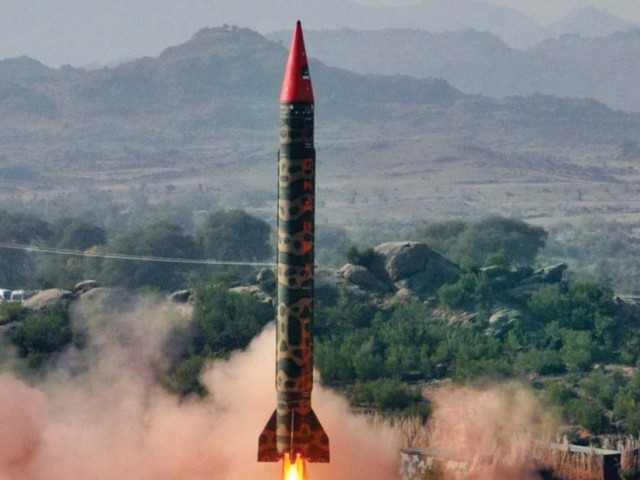
Pakistan successfully test-fires MRBM Hatf V (Ghauri)

Print Friendly and PDF

RAWALPINDI: Pakistan today successfully conducted the training launch of Medium Range Ballistic Missile (MRBM) Hatf V (Ghauri).The launch was conducted by a Strategic Missile Group of the Army Strategic Force Command on the culmination of a field training exercise that was aimed at testing the operational readiness of the Army Strategic Force Command. Ghauri ballistic missile is a liquid fuel missile which can carry both conventional and nuclear warheads over a distance of 1300 kms.The test monitoring of the launch was conducted at the National Command Centre through the medium of National Command Authority s fully automated Strategic Command and Control Support System (SCCSS). 


It may be recalled that the SCCSS enables robust Command and Control capability of all strategic assets with round the clock situational awareness in a digitized network centric environment to decision makers at the National Command Centre (NCC). The test consolidates and strengthens Pakistan s deterrence capability, and national security.The President and Prime Minister congratulated all ranks of the Army Strategic Force Command on the excellent standard achieved during training which was reflected in the proficient handling of the weapon system in the field and the accuracy of the training launch

Pakistan Cyber Force

Thursday, September 6, 2012

The Indo-Pak War of 1965 - When the Nation wrote its Destiny

Print Friendly and PDF

The Indian forces intruded into Pakistani area in the Rann of Kutch in April 1965. In a sharp and short conflict, the Indian forces were ejected. Both the armies had fully mobilized, with eyeball to eyeball contact. Pakistan proposed cease-fire, India accepted. An agreement was signed: the forces disengaged. The Award by the Arbitration Tribunal vindicated Pakistan 's Position.

Past midnight on 5/6 September, without a formal declaration of war, Indian Army crossed the international border and attacked Lahore and Kasur fronts. Pakistan Army and Pakistan Air Force halted the attack in its tracks, inflicting heavy casualties on the aggressor. On 7 September a single Pakistan Air Force Pilot, Squadron Leader M.M. Alam, Sitara-i-Juraat, in his F-86 Sabre shot down five Indian Air Force attacking Hunter aircraft in a single sortie, an unbeaten world record “On night 6/7 September three teams of our Special Services Groups were para-dropped on Indian Air Force bases at Pathankot, Adampur and Halwara to neutralize them.

To relieve pressure on Lahore front, on night 7/8 September, after crossing two major water obstacles in a bold thrust, Pakistani armoured and mechanized formations supported by artillery and Pakistan Air Force overran area Khem Karn, 6 to 8 miles inside Indian territory. Vital Indian positions at Sulemanki and across Rajasthan and Sindh were also captured in bold, swift attacks.
     
On night 7/8 September, 1 Corps of Indian Army launched its main effort east of Sialkot with one armoured and three infantry divisions on our extended 15 Division front, screened only by gallant 3 Frontier Force and B Company 13 Frontier Force (Reconnaissance & Support). 24 Infantry Brigade (Brigadier A.A Malik, Hilal-i-Juraat) on the move in area Pasrur, rushed 25 Cavalry (Lieutenant Colonel Nisar Ahmad, Sitara-i-Juraat), on 8 September to delay and disrupt enemy thrusts. As soon as the presence of Indian 1 Armoured Division was confirmed, Pakistan Army rushed forward to stop the onslaught on a 30-mile front. The biggest tank battle since World War II was fought on the Chwinda front by 6 Armoured Division with under command 24 Infantry Brigade Groups and valiantly supported by 4 Corps Artillery (Brigadier A.A.K. Choudhry, Hilal-i-Juraat). The main effort of the Indian Army was blunted, inflicting heavy and troop casualties. Pakistan Air Force support helped turn the tide of the battle. Before a counter offensive by 6 Armoured Division on 22 September could be launched, Indian asked for cease-fire in the United Nations. India 's aggression against our international borders without a formal declaration of war had cost it, apart from heavy personnel, material land economic losses, 1617 sq. miles of territory as compared to 446 sq. miles of our open and undefended territory. Pakistan Army captured 20 officers, 19 Junior Commissioned Officers, and 569 Other Ranks.

The Indian forces intruded into Pakistani area in the Rann of Kutch in April 1965. In a sharp and short conflict, the Indian forces were ejected. Both the armies had fully mobilized, with eyeball to eyeball contact. Pakistan proposed cease-fire, India accepted. An agreement was signed: the forces disengaged. The Award by the Arbitration Tribunal vindicated Pakistan 's Position.

Past midnight on 5/6 September, without a formal declaration of war, Indian Army crossed the international border and attacked Lahore and Kasur fronts. Pakistan Army and Pakistan Air Force halted the attack in its tracks, inflicting heavy casualties on the aggressor. On 7 September a single Pakistan Air Force Pilot, Squadron Leader M.M. Alam, Sitara-i-Juraat, in his F-86 Sabre shot down five Indian Air Force attacking Hunter aircraft in a single sortie, an unbeaten world record “On night 6/7 September three teams of our Special Services Groups were para-dropped on Indian Air Force bases at Pathankot, Adampur and Halwara to neutralize them.

To relieve pressure on Lahore front, on night 7/8 September, after crossing two major water obstacles in a bold thrust, Pakistani armoured and mechanized formations supported by artillery and Pakistan Air Force overran area Khem Karn, 6 to 8 miles inside Indian territory. Vital Indian positions at Sulemanki and across Rajasthan and Sindh were also captured in bold, swift attacks. 
  

On night 7/8 September, 1 Corps of Indian Army launched its main effort east of Sialkot with one armoured and three infantry divisions on our extended 15 Division front, screened only by gallant 3 Frontier Force and B Company 13 Frontier Force (Reconnaissance & Support). 24 Infantry Brigade (Brigadier A.A Malik, Hilal-i-Juraat) on the move in area Pasrur, rushed 25 Cavalry (Lieutenant Colonel Nisar Ahmad, Sitara-i-Juraat), on 8 September to delay and disrupt enemy thrusts. As soon as the presence of Indian 1 Armoured Division was confirmed, Pakistan Army rushed forward to stop the onslaught on a 30-mile front. The biggest tank battle since World War II was fought on the Chwinda front by 6 Armoured Division with under command 24 Infantry Brigade Groups and valiantly supported by 4 Corps Artillery (Brigadier A.A.K. Choudhry, Hilal-i-Juraat). The main effort of the Indian Army was blunted, inflicting heavy and troop casualties. Pakistan Air Force support helped turn the tide of the battle. Before a counter offensive by 6 Armoured Division on 22 September could be launched, Indian asked for cease-fire in the United Nations. India 's aggression against our international borders without a formal declaration of war had cost it, apart from heavy personnel, material land economic losses, 1617 sq. miles of territory as compared to 446 sq. miles of our open and undefended territory. Pakistan Army captured 20 officers, 19 Junior Commissioned Officers, and 569 Other Ranks.

1965 War, the Inside Story by R.D. Pradhan:
 

In Chapter 8 titled “Of Cowardice and Panic”, the author describes the cowardice of Maj. Gen. Niranjan Prasad, the Indian general commanding officer in Lahore sector. When the general was fired
 upon by Pakistani forces, he “ran away”. On learning that, Lt. Gen. Harbakash Singh and the corps commander drove in a Jonga to the battlefront. Army commander found that the enemy (PAF) air attack had created a havoc on G.T. Road. (Indian) Vehicles were burning and several vehicles of 15 Division abandoned on the road, the drivers having run away, leaving some of the engines still running. Maj. Gen. Niranjan Prasad was hiding in a recently irrigated sugar cane field.

As described by Harabakash Singh: “He (Prasad) came out to receive us, with his boots covered with wet mud. He had no head cover, nor was he wearing any badges of his rank. He had stubble on his face, not having shaved.” Seeing him in such a stage, Harbakhash Singh asked him: “Whether he was the General Officer commanding a division or a coolie? Why had he removed badges of rank and not shaved? Niranjan Prasad had no answer.”


Our Armed Forces are doing their duty more than well to this very day, but the question is, are we?

Tuesday, August 21, 2012

Valliant Security Forces Foiled Kamra Assault

Print Friendly and PDF


Present different war between Pakistan’s security forces and the militants is simply a ‘clash of wills’ between two entities. In his book, “Fighting Power: German and U.S. Army Performance, 1939-1945”, Creveld identifies the elements of moral force, whom he calls “fighting power, the willingness to fight and the readiness, if necessary, to die.” The greater these elements, the less vulnerable an armed force will be to demoralisation.

In these terms, when nine militants disguised in security forces’ uniform, equipped with latest guns, and rocket launchers attacked Pakistan Air Force Base at Kamra on August 16, the valiant personnel of Pakistan Air Force and Special Service Group (SSG) of Commandoes of Pak Army foiled the assault by killing all the terrorists. Only one soldier was martyred.

According to PAF sources, fierce gun-battle took place between the security forces and blasts were also heard. It shows that both the warring parties were well-equipped with arms and weapons. While, on the one side, terrorists were also mentally prepared to die in order to complete their mission, on the other side, besides their professional training, Air force soldiers were also ready to die so as to castigate the terror-assault. In this situation, PAF soldiers defeated the militants due to their courage and spirit of sacrifice.

The fearlessness of the Air Force personnel could be judged from the fact that the Base Commander Air Commodore Azam Khan, who led the operation from the front, also sustained bullet injuries. Although Pakistan Air force soldiers were already on the state of high alert after receiving the related-information, but the coward insurgents tried to attack in the wee hours of the night. The security arrangements, consisting of four tiers have been able, not only to stop the terrorists on the 2nd tier and also killed them.

Notably, terrorists mostly succeed in their attempts as past experience indicates in Pakistan and other volatile countries. Let us take the example of Afghanistan where in more than ten years, well-trained NATO forces, equipped with latest weaponry have failed in stopping sudden terror attacks on their bases and military installations. In fact, they have been demoralised as they lack the passion of sacrificing their own lives and fighting spirit. Besides, militants are at advantage in this new style war because of their surprise and sudden strikes. And it is a war in which offence knows its target, but defence does not know.

Despite all of this, vigilance and preparedness of the PAF forces-ready to act is praiseworthy as they successfully foiled the militants’ sudden and surprise assault on the Kamra Base. It is notable that the Kamra Airbase is the home to the Pakistan Aeronautical Complex that assembles Mirage and with Chinese support, JF-17 fighter jets. Normally, about thirty aircraft remain parked at the airbase.

In this respect, when the militants tried to enter the base, Air Force personnel present on the spot immediately responded and resisted the terrorists who seek to approach the aircraft. The intrusion was followed by a gun-battle between security forces and assailants which started at 2:00 AM and continued till 6:00 AM. It was owing to the quick action that the terrorists who wanted to destroy all the aircraft and to kill the security forces there, failed in their sinister designs.

Although, like the recent subversive activities in other cities of Pakistan, Tehreek-e-Taliban Pakistan (TTP) has claimed the responsibility for the attack at Kamra Base, yet this terror attempt cannot be seen in isolation. There is no doubt that that secret agencies like American CIA, Indian RAW and Israeli Mossad which have established their collective network in Afghanistan are in collusion, and have been supporting bomb blasts, suicide attacks, abductions, target killings, ethnic and sectarian violence in various cities of Pakistan through their affiliated militant groups in order to fulfill their secret strategic designs against Pakistan. Particularly, RAW has hired the services of many Indian Muslims. Posing themselves as militants, they have joined the ranks and files of TTP and other insurgent outfits.

In this context, intermittent drone attacks and cross-border terrorism in Pakistan from Afghanistan’s side is also part of the anti-Pakistan scheme. Pakistan’s Federal Interior Minister Rehman Malik and some high civil and military officials have repeatedly stated that training camps are presence in Afghanistan, and supply of arms and ammunition to the Pakistani Taliban continue by the external elements as part of a plot against Pakistan. It is of particular attention that terror attack at Kamra Base has coincided with the statement of US Defence Secretary Leon Panetta who said on August 16, “There is a danger of nuclear weapons of Pakistan, falling into hands of terrorists.”

Panetta’s misperception was also shared by a baseless report, published in the New York Times on the same day, which said that suspected militants attacked a major Pakistani Air Force base where some of the country s nuclear weapons were considered to be stored in the early hours of the militants’ attack.

Moreover, US top officials have intensified their pressure on Islamabad to launch joint military operations against the Haqqani network, based in North Waziriran. Meanwhile, a recent report of The Telegraph, quoting Leon Panetta indicated that “Pakistan military is planning to start an operation against militants in North Waziristan.” Undoubtedly, our nukes are in safe hands. Taking note of various rumours, after his recent meeting with Gen. James N. Mattis, Commander US CENTCOM, on August 17, Chief of Army Staff Gen. Ashfaq Parvez Kayani categorically dispelled the speculative reporting in foreign media, regarding joint operations in North Waziristan. He reiterated, “We might, if necessary, undertake operations in NWA, in the timeframe of our choosing. It will never be a result of any outside pressure.

Nevertheless, there is a co-relationship of all these anti-Pakistan developments. Nonetheless, valiant security forces of Pakistan which have totally foiled the Kamra- terror assault in a short span of time, has proved their alertness and heroic act.

By Sajjad Shaukat
He writes on international affairs and is author of the book: US vs Islamic Militants, Invisible Balance of Power: Dangerous Shift in International Relations


Pakistan Cyber Force

Related Posts Plugin for WordPress, Blogger...