Pakistan Cyber Force: Spain

Top stories

Pakistan Cyber Force [Official]

Showing posts with label Spain. Show all posts

Monday, January 20, 2014

Massive Unrest Explodes in 46 Cities across Spain

Print Friendly and PDF


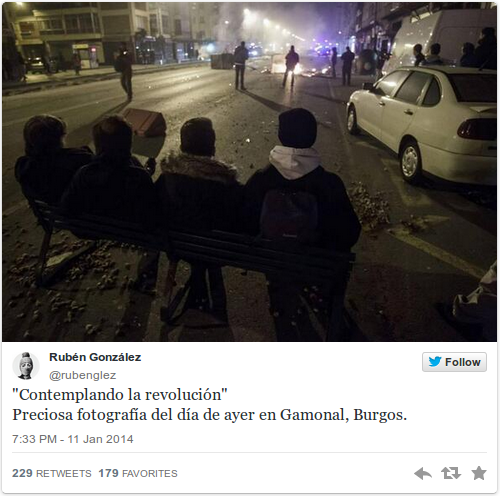
What started as an isolated incident in Burgos, over a disagreement with government spending on local infrastructure, has quickly spread throughout Spain.


46 protests have taken place throughout Spain, with dozens arrested and major clashes with police.

Read on Twitter
In Barcelona, government forces have even resorted to war tactics with ‘sonar weapons’ after protesters attacked a police station:


Here a photo showing government forces using a Long Range Acoustic Device (LRAD) against civilians:
Read on Twitter
Even firefighters have joined the protesters:
Read on Twitter

Is Spain on the verge of a bloody revolution against European Union's Pro-Israhelli Monarchs?

Pakistan Cyber Force

Friday, January 17, 2014

Major Social Unrest, Riots break out in Spain

Print Friendly and PDF

At least 20 have been arrested and 12 injured during riots in Burgos, Spain.
Melilla is also getting its fair share of social unrest.

Is Spain witnessing the beginning of a major social revolution or is it nothing but a pocket of anger venting and evaporating into thin air?


Pakistan Cyber Force

Monday, February 4, 2013

History Distorted: Columbus was NOT the First To Cross The Atlantic

Print Friendly and PDF


The old poem that most American school children recognize begins “In 1492, Columbus sailed the ocean blue…” Indeed, in the year 1492, Christopher Columbus (whose real name in Italian was Cristoforo Colombo) sailed across the Atlantic in the name of the Spanish crown and landed in the Caribbean part of North America. For hundreds of years, it has simply been accepted that Columbus was the first explorer to valiantly sail across the sea and “discover” the Americas. However, this theory no longer stands up to modern scholarship.

It goes without saying that the first people to truly discover America were the ancestors of the Native Americans, who probably crossed into North America through Russia and Alaska about 12,000 years ago. Discussion of the “discovery” of the Americas by Europeans, Africans, or Asians is an insult to the history of its indigenous peoples. That said, the first daring souls to cross the Atlantic Ocean by boat are important to know, and the theory of Columbus does no justice to their story.

While the common knowledge about Columbus is that he lived in a time where everyone assumed the world was flat, this is clearly not the case. Ancient Greek scholars such as Aristotle and Pythagoras suggested that the earth was in fact, round. It was during the Muslim Golden Ages (c. 750-1100s) that advanced scholarship into the shape and size of the earth began. Contrary to what most people may believe, in those years, it was common understanding that the earth was not flat. The debate, instead, was about exactly how large the earth was. In the early 800s, the Abbasid Caliph al-Ma’mun assembled the brightest minds of the day (including al-Khawarizmi) in Baghdad who calculated the earth’s circumference and were off by only 4% of it’s actual size.

Knowing that the earth was round, and knowing its size to a very good degree of accuracy (without the modern technology we have today), some intrepid Muslims must have attempted to go around the world, hundreds of years before Columbus. The proof of these voyages is in front of us, in black and white.

Muslim Spain


Al-Masudi’s world map of 956, showing the “unknown land” across the Atlantic across from Africa
The great Muslim historian and geographer, Abu al-Hasan al-Masudi wrote in 956 of a voyage in 889 from al-Andalus (Muslim Spain). The voyage left from the port of Delba (the same place Columbus’ voyage would begin) and sailed for months westward. They eventually found a large landmass across the ocean where they traded with the natives, and then returned to Europe. Al-Masudi records this land across the ocean in his famous map and refers to it as “the unknown land”.

Two more voyages from Muslim Spain to the Americas are recorded in history. One was in 999 and was led by Ibn Farrukh, from Granada. The other is recorded by the genius mind of the geographer al-Idrisi, who worked in the multi-cultural and religiously tolerant Sicily of King Roger II in the 1100s. He wrote of a group of Muslims who sailed west from Lisbon for 31 days and landed on an island in the Caribbean. They were taken prisoner by the Native Americans on that island for a few days. Eventually, they were freed when a translator who lived among the natives that spoke Arabic arranged for their release. They eventually sailed back to al-Andalus and told their tale. The important part of this account is the existence of an Arabic speaker among the natives, indicating that there must have been more unrecorded contact between the Arab world and the Americas.

West Africa

There is another part of the Muslim world that had contact with the Americas before Columbus. In West Africa in the 1300s, a powerful and incredibly wealthy empire called Mali existed. The most famous leader of this empire was Mansa (king) Musa. The most memorable event of his reign was his epic hajj journey in 1324. The caravan of over 60,000 people made an impression everywhere they went, including Egypt, where Mansa Musa told the story of how he came to power. His brother, Abu Bakr was the Mansa before he was. During his reign, Abu Bakr sent a fleet of 400 ships to explore the Atlantic Ocean. Only 1 ship returned, but reported that they found a land across the ocean. Mansa Abu Bakr then outfitted a fleet of 2000 ships, which he sailed with personally, that sailed west into the ocean. They were never heard from again.

While there is no record in Mali of the result of that voyage, there is evidence of their arrival in the Americas. There are numerous archaeological sites in North and South America that attest to that Malian presence. Early Spanish explorers and pirates recorded abandoned cities in Brazil that had inscriptions identical to the language of the Mandinka (the people of Mali). More inscriptions in the Mandinka language were found in the United States as well. Near the Mississippi River, many inscriptions exist that recorded their exploration of the Americas. In Arizona, an inscription was found that reads “The elephants are sick and angry. At present there are many sick elephants”. This inscription also includes a rough sketch of an elephant. Elephants are not native to the Americas. They were brought by the Mandinka to the Americas, and the inscriptions are proof of Mansa Abu Bakr’s successful journey over 100 years before Columbus.

The Ottoman Empire

In 1929, an amazing discovery was made in Istanbul, Turkey. A map drawn in the year 1513 by the Ottoman cartographer, Piri Reis was found. Reis wrote that his map was based on earlier sources, including ancient Greek and Arabic maps, including maps by Christopher Columbus, who had sailed only 21 years earlier. What is remarkable about this map is the level of detail of the map, which forced historians to re-evaluate the Columbus theory of exploration.
The Piri Reis map of 1513

The map clearly shows the eastern coast of South America, which is in the correct position with regards to Africa. The coast of Brazil is shown in incredible detail, with many rivers accurately placed on the map. Although Reis used Columbus’s maps as a source, Columbus never went to South America, so Reis must have gotten that from earlier Muslim maps that he used as sources. Furthermore, Reis’s map includes the Andes Mountains, which were not even explored by Europeans until the 1520s, a full decade after the drawing of Reis’s map!

Piri Reis based his map on earlier sources, which clearly had a very good understanding of the Americas and had explored the area well before the first Europeans. The map is perhaps the strongest physical evidence of Muslim exploration of the Americas before Columbus

What Did Columbus Say?

With all of this evidence of Muslim exploration before Columbus’s voyage in 1492, is it possible that Columbus himself knew he was not the first? It’s more than likely to be the case. Columbus sailed from Spain in the same year the last Muslim dynasty of Iberia was destroyed in the Reconquista. Many of the people of Iberia were still Muslims, and carried with them the knowledge of the Muslim Golden Ages. Numerous people on Columbus’s voyage were Moriscos, Muslims who were forced to convert to Catholicism or die. Columbus could have heard from Spain’s Muslims of the New World and was thus inspired to go exploring.

Once he got to the Americas, Columbus records numerous examples of Muslims already present. He commented on the gold that the natives had, which was made the same way, in the same alloy, as the Muslims of West Africa did. Furthermore, Columbus records that the native word in that area for gold is guanin, which is very similar to the Mandinka word for gold, ghanin, which probably comes from the Arabic word for wealth, ghina’.

In 1498, Columbus recorded seeing a ship loaded with goods, heading towards America, filled with Africans who were probably on their way to trade with Native Americans. Columbus also records in his journal that Native Americans told him of black Africans who came regularly to trade with them.

Even Columbus knew that he was not the first to cross the Atlantic Ocean.

Conclusions

Clearly, the theory that Columbus discovered America is nothing but an old tale that has not stood the test of time. There is no doubt that the Columbian Era was a pivotal time in world history that changed the way of life in the Americas and Europe forever. However, he was not the first to make the crossing to the Americas. Evidence exists from the Arabs, West Africans, and Ottomans of Muslim voyages to the Americas well before Columbus and Christian Europe. For whatever reason, the textbooks continue to extoll the voyage of Columbus and the courage of his crew, the “first” to make it across the Atlantic. This idea clearly needs to be re-examined in light of evidence from earlier Muslim explorations, to bring their contributions to the general public.

Sources:

Dirks , J. (2006). Muslims in American History . Beltsville, MD: Amana Publications.

Morgan, M. (2007). Lost History. Washington D.C. : National Geographic Society.

Quick, A. H. (2007). Deeper Roots. (3rd ed.). Cape Town: DPB Printers and Booksellers.

Friday, November 23, 2012

Spain facing ‘humanitarian’ crisis over evictions

Print Friendly and PDF


As eviction-related suicides continue to rise in Spain, protests are becoming more frequent with the public outraged at the government’s lack of action to combat social ills. Evictions are a “humanitarian concern,” the national bank chief has said. The governor of the Bank of Spain, Luis Maria Linde, said that the increasing number of evictions related to financial woes should be combated through “social initiatives.” The evictions have driven over 100 people to commit suicide, and mass protests on the issue have become a regular occurrence in Spain.

“We must urgently address and social humanitarian issues, this will have to be organized, but we can do it,” Linde said, adding that the root cause of the crisis was a lack of information and reliable statistics. There have been numerous calls in Spain for a modification of mortgage law in order to mitigate evictions and stem a mounting social crisis. One particular concern is legislation that forces those evicted to continue to make mortgage payments even after they have been ejected from their former property. Spanish Prime Minister Mariano Rajoy condemned the law for allowing “inhuman situations” to transpire on a daily basis, but the government has yet to take action on the matter.

Linde broached the issue, saying that it was very “delicate.” He argued that the most important issue was ensuring that the mortgage system remains stable, as it is one of the cornerstones of the Spanish banking system. Around 500 people are ejected from their homes every day in the crisis-wracked nation, a 30 percent increase over last year, Spanish publication LaTercera said. The report estimates that around 2 million homes across Spain are currently unoccupied. ‘Homicide not suicide’ The suicide of 53-year-old Amaia Egaña – who jumped to her death from the fourth floor of her building after she was issued an eviction notice for defaulting on her mortgage payments – sparked outcry across Spain two weeks ago. Thousands of people in the Basque region marched to protest mortgage legislation, chanting slogans such as “This isn’t suicide, this is homicide,” “They get the money and we get the dead,” and “We need to put an end to financial terrorism.”

Cases like Egaña’s are an increasingly common occurrence in a country where unemployment is over 25 percent, and seems likely to keep rising. At the end of October, three suicides driven by the financial downturn reportedly took place in three consecutive days. A young man threw himself off a bridge in Gran Canaria after losing his job and receiving an eviction notice, while a 53-year-old father kissed his daughter goodbye in Burjassot before jumping from his second-story flat. In the southern province of Granada, 54-year-old Jose Miguel Domingo hanged himself minutes before the bailiffs arrived to evict him from his home. The growing suicide rate across Spain has sparked mass protests and calls for the immediate reform of mortgage legislation. Since the beginning of this year, over 100 Spaniards have killed themselves over financial woes.

(RT)
Pakistan Cyber Force

Thursday, October 11, 2012

S&P Downgrades Spain to just above JUNK Status

Print Friendly and PDF

Spain’s credit rating has been downgraded by American ratings agency Standard & Poor's by two notches, leaving it at the lowest investment-grade status, BBB-. ­The Spanish government's options for averting a national financial crisis are limited by a grinding recession, high unemployment and social unrest, S&P said in a statement. The agency also assigned a negative outlook to the rating. Financial institutions were not at all surprised by such a development.

“The Spanish government itself has come out and said, 'look, come 2013, our debt-to-GDP ratio is going to be approximately 91%,'” Margaret Bogenrief from financial advisory ACM Partners told RT. “Debt is growing. There is no internal growth within the Spanish economy to boost those GDP numbers.” “So as far as everyone focusing on what the S&P and other rating agencies are saying,” Bogenrief said, “I think they’re actually reflecting the reality that the Spanish economy is not going anywhere good for the rest of 2012 and into 2013.”

It was predicted that the European bailout fund would help recapitalize Spanish banks without piling on more debt, but now, “any recapitalization plan will likely add more debt” to the central government in Madrid, the S&P statement said. Spain has not asked for outside help, for example a bailout from the European Central Bank. Instead, the government decided to deal with the deficit by introducing a number of austerity measures, causing popular discontent across the nation, where nearly one in four is unable to find work.

“The Spanish population has demonstrated that they are comfortable protesting and rioting these matters. I think you will see more riots, I think you will see more civil unrest, just like you see in Greece. At the very least, the Spanish economy needs 100 billion euro to get back on its feet, and as Greece demonstrated… you may need a second round,” Bogenrief said.

Pakistan Cyber Force

Thursday, June 14, 2012

Economic Collapse: Spain's Credit Rating 3 Notches Down, Cyprus 2: Moody's

Print Friendly and PDF

Rating agency Moody's has cut its rating on Spanish government debt by three notches from A3 to Baa3. Cyprus’s sovereign debt was lowered by two notches from Ba1 to Ba3.

The agency said Wednesday that Spain’s debt burden would increase once the EU has approved a plan to help the country's banks. It has Spain under further review and could lower its rating even further, Reuters reports. Moody’s points out that the Spanish government has "very limited" access to international debt markets and notes the general weakness of the country's economy.

For Cyprus, Moody’s is citing the increased risks of a Greek exit from the eurozone and its generally unstable fiscal position, while Cyprus has close cultural, business and political links with this country. Just like Spain, Cyprus was also put on review for further downgrade. Its weak credit position is jeopardized by limited access to international markets, Moody's said in a statement.

Spain is the eurozone's fourth biggest economy, while Cyprus is the third smallest.

Moody’s is currently in a process of a wider review of European banking systems. It has recently cut credit ratings of banks in Italy, Spain, Portugal and the Nordic region. The remaining reviews of other European banking systems are expected to be concluded by the end of June.


Sunday, May 6, 2012

Economic Collapse: Spain's Unemployment Rate hits record high at 24.44%

Print Friendly and PDF

Unemployed people in Spain.
Newly released figures show Spain’s unemployment rate hit a new record high at the end of March, reaching 24.44 percent.
 
With the highest rate since 1996, the data released by Spain's National Statistics Institute indicate that some 5.6 million people are now jobless, AFP reported.

This comes hours after the New York-based Standard & Poor’s ratings agency downgraded Madrid’s long-term sovereign credit rating from A to BBB+, giving it a negative outlook.

Earlier this month, Spain’s Labor Ministry had announced a rise in the country’s jobless rate for March, saying an estimated 4.75 million people were unemployed.

In the first quarter of the year, some 37,000 jobs were lost in Spain.

The eurozone’s fourth largest economy has announced spending cuts of more than 11-billion dollars as well as tax increases to reduce the country's deficit to avoid seeking a financial bailout like Greece, Ireland, and Portugal.

Battered by the global financial downturn, the Spanish economy collapsed into recession in the second half of 2008, destroying millions of jobs.

A number of analysts have on several occasions said that Spain's economy is expected to be hit by a new recession in the first two quarters of 2012.
 

Tuesday, April 24, 2012

Neither Cuts, Nor Spending Solve European Crisis – Expert

Print Friendly and PDF

As the Spanish economy shows signs of a deeper recession, EU authorities argue whether budget cuts or money injection would solve the crisis. But neither of them is a solution, according to Roland Nash from Verno Capital. ­On Monday Bank of Spain confirmed the country’s economy plunged into recession in the first quarter of 2012 as the labor market situation worsened. The GDP fell by an estimated 0.4% in the first quarter after a 0.3% decline in the last three months of 2011. Though the recession sparked fears the country would follow Greece, Mr Nash says the probable bailout for Spain is not the major problem. “It’s not a question if Spain will be next, but how Europe and the world are trying to deal with evolving problem,” Mr Nash told RT. “If it’s not Spain it would be Portugal”.


Mr Nash pointed out only the structural reforms of the euro-zone’s management would help to deal with the crisis effectively. “The solution is the real change in the way Europe has been managing, its business environment and attitude. It’s a structural change, not austerity or spending,” Mr Nash said. But European governments need political will to provide these reforms, he added. He went on: “You’re not going to get out of it [crisis] by austerity, it has to be more than just causing pain in peripheral Europe. The increased spending is not going to solve the problem either,” Mr Nash explained. Currently Germany and France press for further austerity measures for the debt troubled euro-zone countries in a so called fiscal treaty. On the other hand the International Monetary Fund raised $430 billion as a firewall against the global crisis amid renewed worries on European debt crisis sparked by Spanish and Italian budget problems. “Europe needs to do a lot of difficult structural changes. Money on its own only solves the problem in a short term,” he stressed.
(RT)
Enticing Fury
Pakistan Cyber Force

Spain's Economy plunges into recession: Central Bank

Print Friendly and PDF

MADRID: Spain's jobs-scarce economy plunged back into recession in the first quarter of 2012 as employment slumped even further, the Bank of Spain said Monday. Just two years after emerging from the last downturn, Spain slid into recession again with two consecutive quarters of economic contraction, the central bank said in a report. Gross domestic product fell an estimated 0.4-percent in the first quarter of 2012 after a 0.3-percent decline in the last three months of 2011, the bank said. Spain, whose unemployment rate at the end of 2011 was already the highest in the industrialised world at 22.85 percent overall and nearly 50 percent for the young, suffered a further jobs slump. "Employment fell again, sharply, with an estimated year-on-year decline of 4.0 percent," the report said, noting also a "significant" fall in unit labour costs. The government forecasts the jobless rate will rise to 24.3 percent this year as the sagging economy struggles to absorb millions of workers who lost their jobs when a property bubble collapsed in 2008.

The European Central Bank had helped to ease market tensions, Spain's bank said, alluding to more than one trillion euros ($1.32 trillion) in low-interest, three-year ECB loans to for the bloc's banks. Worries were further eased by an international rescue programme for Greece, by the restructuring of Greek debt and by eurozone economic governance reforms, it said. "Nevertheless, the instability returned in the first days of April, affecting Spain and Italy with particular strength because of doubts raised by the adjustment process in which both countries find themselves." New tensions pushed the borrowing rate on Spain's benchmark 10-year government bonds above a symbolic 6.0-percent threshold, the central bank noted.

Investors in Spanish 10-year bonds demanded an additional return of about 440 basis points when compared to German bonds and at the same time, the stock market has slumped by about 20 percent since the beginning of the year. The decline intensified Monday as Madrid's IBEX-35 index of leading shares slumped 206.20 points or 2.93 percent to 6,834.40 points by late afternoon, hit by concerns over the French presidential election and Spain's debt. Investors fretted after French Socialist Francois Hollande beat President Nicolas Sarkozy in a first round of voting Sunday. The pair face off in a final round May 6. Spanish markets were among those hardest hit, in part because of doubts over Madrid's ability to meet its public debt-cutting goals and thus prevent its sovereign debt mushrooming beyond control. "The gloomy outlook reflects the government's determination to cut the public-sector budget deficit from 8.5 percent of GDP in 2011 to 3.0 percent by 2013," said Raj Badiani, economist at the IHS economic and industrial information group.

Although Spain had pledged austerity measures worth 27 billion euros in its 2012 budget, more would be needed to achieve the deficit-cutting goal, he warned in a report. Analysts say the recession will make those targets even harder to reach, as tax income declines and welfare costs rise. Household consumption, accounting for 60 percent of GDP, was now a key concern, Badiani said. "Consumers will continue to spend timidly, worried about staggeringly high unemployment, shrinking house equity (values) and still-excessive debt levels, coupled with compelling evidence that Spain is set for a prolonged and deep recession," he warned.

Enticing Fury
Pakistan Cyber Force

Tuesday, February 21, 2012

Spain erupts against EU, IMF Dacoits

Print Friendly and PDF

MADRID - Hundreds of thousands of people, many waving red and white union flags, protested across Spain on Sunday against sweeping labour market reforms that make it easier to slash pay and lay off workers. Spain's two biggest unions, the CCOO and UGT, led protests in 57 cities against the reforms which Spain's new conservative government argues are needed to slash a jobless rate of 22.85 percent, the highest in the developed world. The two largest protests were held in Madrid and Barcelona, Spain's second city. They drew hundreds of thousands of demonstrators, according to AFP reporters at the scene.

Union officials said 500,000 people hit the streets in Madrid, 400,000 in Barcelona, 150,000 in Valencia and 50,000 in Seville. Police offered far lower participation figures. They said 50,000 people turned out in Madrid, 30,000 in Barcelona, 25,000 in Valencia and 5,000 in Seville. In the Spanish capital, protesters marched under sunny skies behind a large banner that read "No to the unfair, inefficient and useless reform".

Enticing Fury
Pakistan Cyber Force

Related Posts Plugin for WordPress, Blogger...