Pakistan Cyber Force: Economic collapse of Europe

Top stories

Pakistan Cyber Force [Official]

Showing posts with label Economic collapse of Europe. Show all posts

Wednesday, January 22, 2014

Ukraine: Deadly Clashes Erupt between Protesters and Riot Police

Print Friendly and PDF

Protesters have escalated their game in Kiev, Ukraine. Chaos appears to reign in the city, with streets covered in burning tires and clouds of tear gas.

Video: Ukraine police filmed beating rioters


Over 200 police officers have been injured and two people were reportedly killed. Given that none of the law enforcement officers carry firearms, it appears to clearly show that third parties are instigating even more violence.
Rioters have created barricades using burnt vehicles.

Rioters have made barricades of burnt police cars
While riot police have also turned to throwing molotov cocktails.

Pakistan Cyber Force

Monday, January 20, 2014

Massive Unrest Explodes in 46 Cities across Spain

Print Friendly and PDF


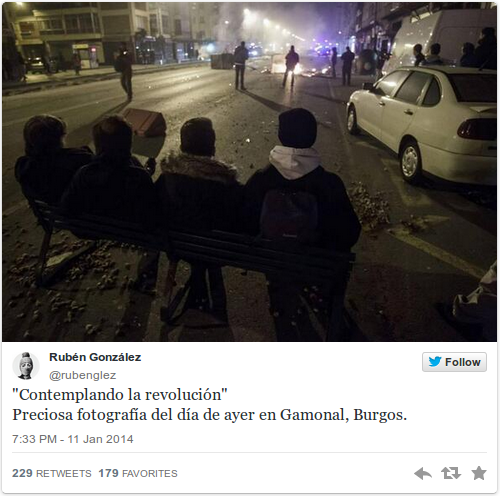
What started as an isolated incident in Burgos, over a disagreement with government spending on local infrastructure, has quickly spread throughout Spain.


46 protests have taken place throughout Spain, with dozens arrested and major clashes with police.

Read on Twitter
In Barcelona, government forces have even resorted to war tactics with ‘sonar weapons’ after protesters attacked a police station:


Here a photo showing government forces using a Long Range Acoustic Device (LRAD) against civilians:
Read on Twitter
Even firefighters have joined the protesters:
Read on Twitter

Is Spain on the verge of a bloody revolution against European Union's Pro-Israhelli Monarchs?

Pakistan Cyber Force

Friday, January 17, 2014

Major Social Unrest, Riots break out in Spain

Print Friendly and PDF

At least 20 have been arrested and 12 injured during riots in Burgos, Spain.
Melilla is also getting its fair share of social unrest.

Is Spain witnessing the beginning of a major social revolution or is it nothing but a pocket of anger venting and evaporating into thin air?


Pakistan Cyber Force

Monday, June 3, 2013

Massive Economic Collapse is Erupting all over Planet Earth - Be Warned!

Print Friendly and PDF


This is no time to be complacent.  Massive economic problems are erupting all over the globe, but most people seem to believe that everything is going to be just fine.  In fact, a whole bunch of recent polls and surveys show that the American people are starting to feel much better about how the USZ economy is performing.  Unfortunately, the false prosperity that we are currently enjoying is not going to last much longer.  Just look at what is happening in Europe.  The eurozone is now in the midst of the longest recession that it has ever experienced.  Just look at what is happening over in Asia.  Economic growth in India is the lowest that it has been in a decade and the Japanese financial system is beginning to spin wildly out of control.  One of the only places on the entire planet where serious economic problems have not already erupted is in the United States, and that is only because we have "kicked the can down the road" by recklessly printing money and by borrowing money at an unprecedented rate.  Unfortunately, the "sugar high" produced by those foolish measures is starting to wear off.  We are going to experience a massive amount of economic pain along with the rest of the world - it is just a matter of time.
But for the moment, there are a lot of skeptics out there.

For the moment, there are a lot of people that are declaring that the problems of the past have been fixed and that we are heading for incredibly bright economic times ahead.

Unfortunately, those people appear to be purposely ignoring the economic horror that is breaking out all over the globe.
The following are 18 signs that massive economic problems are erupting all over the planet...
#1 The eurozone is now in the midst of its longest recession ever.  Economic activity in the eurozone has declined for six quarters in a row.
#2 Italy's economy has now been contracting for seven quarters in a row.
#3 Industrial production in Italy has fallen for 15 months in a row.  It has now fallen to its lowest level in about 25 years.
#4 The number of people that are considered to be "seriously deprived" in Italy has doubled over the past two years.
#5 Consumer confidence in France has just hit a new all-time low.
#6 The number of unemployed workers seeking a job in France has hit a brand new all-time record high.  Many unemployed workers in France are utterly frustrated at this point...
"I've sent CVs everywhere, I come to the unemployment agency every day, for 3 or 4 hours to look for work as a truck driver and there's never anything," said 42-year old Djamel Sami, who has been unemployed for a year, leaving a job agency in Paris.
#7 Unemployment in the eurozone as a whole has just hit a brand new all-time record high of 12.2 percent.
#8 Youth unemployment continues to soar to unprecedented heights in Europe.  The following is from an article that was recently posted on the website of the Guardian that detailed how bad things are getting in some of the worst countries...
In Greece, 62.5% of young people are out of work, in Spain it's 56.4%, then Portugal with 42.5%, and then Italy with 40.5%.
#9 Youth unemployment is being partially blamed for the worst rioting that Sweden has seen in many years.  The following is how the Daily Mail described the riots...
Sweden is reeling after a third night of rioting in largely run-down immigrant areas of the capital Stockholm.
In the last 48 hours violence has spread to at least ten suburbs with mobs of youths torching hundreds of cars and clashing with police.
It is Sweden's worst disorder in years and has shocked the country and provoked a debate on how Sweden is coping with youth unemployment and an influx of immigrants.
#10 An astounding 10 percent of all banking deposits were pulled out of banks in Cyprus during the month of April alone.
#11 Economic growth in India is the slowest that it has been in an entire decade.
#12 Suddenly Australia is experiencing some tremendous economic challenges.  The following quotes are from a recent Zero Hedge article...
-“We’re seeing a much sharper contraction in the Australian economy than we’d anticipated four or five months ago”. Coffey MD, John Douglas. The engineering group has seen its shares, which traded above $4 in 2007, hit 10c last week.
-“By 10am, the Fitness First gym in the city is packed full of brokers who’ve had a gutful of sitting at their desk doing nothing – salary cuts are starting and next it will be jobs” Perth broker
-“Oh mate, the funding market is dead. You are now seeing a few deeply discounted rights issues for those that are reaching desperate levels ….. liquidity has completely disappeared” Perth broker
#13 The financial system in Japan is beginning to spin wildly out of control.  The Japanese stock market has now declined about 15 percent from the peak, and many believe that the yen will continue to get weaker and that interest rates in Japan will start to rise significantly.
#14 Global cash flow is declining at a rate not seen since the last recession.  This indicates that we could be headed for a global credit crunch.
#15 Real wages continue to decline in the United States.  Even though we are being told that the USZ is experiencing an "economy recovery", real weekly earnings have declined from $297.79 in 2010 to $295.49 in 2011 to $294.83 in 2012.  (The preceding calculation is based on 1982-1984 dollars)
#16 Wall Street is buzzing about the fact that "the Hindenburg Omen" appeared at the end of last week.  So exactly what is "the Hindenburg Omen"?  The following are the criteria that are used to determine whether it has appeared or not...
1. The daily number of NYSE new 52 Week Highs and the daily number of new 52 Week Lows must both be greater than 2.2 percent of total NYSE issues traded that day.
2. The smaller of these numbers is greater than or equal to 69 (68.772 is 2.2% of 3126). This is not a rule but more like a checksum. This condition is a function of the 2.2% of the total issues.
3. That the NYSE 10 Week moving average is rising.
4. That the McClellan Oscillator ( a market breadth indicator used to evaluate the rate of money entering or leaving the market and interpretively indicate overbought or oversold conditions of the market)is negative on that same day.
5. That new 52 Week Highs cannot be more than twice the new 52 Week Lows (however it is fine for new 52 Week Lows to be more than double new 52 Week Highs).
When the Hindenburg Omen makes an appearance, it supposedly means that the USZ stock market is likely to experience a serious decline within the next 40 days.
#17 As I wrote about the other day, the SentimenTrader Smart/Dumb Money Index is now the lowest that it has been in more than two years.  That means that lots of "smart money" has been getting out of the market and lots of "dumb money" has been pouring in.
#18 Margin debt on the New York Stock Exchange has set a new all-time high.  The following is from a recent Market Oracle article...
Margin debt—that’s the amount of money borrowed to purchase stocks—on the New York Stock Exchange (NYSE) reached its all-time high in April. Margin debt on the NYSE registered at $384.3 billion as the key stock indices hit new record-highs. (Source: New York Stock Exchange web site, last accessed May 29, 2013.) The highest margin debt ever reached prior to this was in July of 2007, when it stood just above $381.0 billion. At that time, just like today, the key stock indices were near their peaks and “buy now before it’s too late” was the prominent theme of the day
Whenever margin debt spikes like this, a stock market crash almost always follows.  If you doubt this, just check out the chart in this article.
Wall Street has had a good couple of years, but it has been a "false prosperity" that has been pumped up by reckless money printing by the Federal Reserve.  Just like all of the other stock market bubbles that we have seen in recent years, this one is going to burst too.  And as Marc Faber recently pointed out, this bubble has been particularly beneficial to the wealthy...
The Fed has been flooding the system with money. The problem is the money doesn't flow into the system evenly. It doesn't increase economic activity and asset prices in concert. Instead, it creates dangerous excesses in countries and asset classes. Money-printing fueled the colossal stock-market bubble of 1999-2000, when the Nasdaq more than doubled, becoming disconnected from economic reality. It fueled the housing bubble, which burst in 2008, and the commodities bubble. Now money is flowing into the high-end asset market - things like stocks, bonds, art, wine, jewelry, and luxury real estate.
Money-printing boosts the economy of the people closest to the money flow. But it doesn't help the worker in Detroit, or the vast majority of the middle class. It leads to a widening wealth gap. The majority loses, and the minority wins.
The fact that the USZ stock market has set new all-time record high after new all-time record high in recent months means very little.  At this point, the stock market has become completely divorced from economic reality.  When this current bubble bursts, the adjustment is going to be very painful.  Wall Street will likely whine and complain and ask for more bailouts, but they may find that authorities are not nearly as sympathetic this time.
Much of the rest of the world is already experiencing the next major wave of the economic collapse.  Reckless money printing by the Fed and reckless borrowing and spending by the federal government may have delayed the inevitable in the United States for a little while, but those measures have also made our long-term problems even worse.
There was one piece of advice that Ben Bernanke included in his commencement speech to students at Princeton recently that I thought was particularly ironic...
"Don't be afraid to let the drama play out."
Will he take his own advice when the next great financial crisis strikes the United States?
That seems very unlikely.
Unfortunately, things are not going to be so easy to fix this next time.
What happened back in 2008 was just a preview.
What is coming next is going to absolutely shock the world.
(The economic collapse blog)
Edited by Pakistan Cyber Force Web Desk

Pakistan Cyber Force

Tuesday, February 12, 2013

Russia emerges as world's Top Gold Buyer, adding 570 metric tons in last decade

Print Friendly and PDF


Over the last decade Russia’s Central Bank acquired 570 metric tons of gold. The amount is almost triple the weight of the American Statue of Liberty and makes Russia the world’s biggest buyer of gold.

The amount is a quarter more than runner-up China, Bloomberg reported on Monday.

Countries like Russia and China use such stockpiles as an economic buffer against another wave of economic crisis or US dollar devaluation as both remain wary of the US Federal Reserve’s stability and prefer to hedge their bets on gold.

It’s also proven a sound investment and opportunity for the Russian state to make money, with gold prices crawling upwards over the past 12 years, gaining 12% in 2012 alone.  On Monday gold traded at $1650 per ounce and analysts expect the price to keep growing in 2013 to reach $1825 by the end of the year. However French investment bank Natixis dampened the outlook by forecasting a drop in price to $1500 by 2014, Finmarket.ru reports.

But the link between high gold prices and falling crude has plagued Russia in the past. In 1998, when Russia defaulted on $40 billion of domestic debt, it took 28 barrels of crude to buy an ounce of gold, according to Bloomberg research. Two years later, when Vladimir Putin came to power, an ounce was worth 11.5 barrels. By 2005 the ratio had dropped to 6.5 and that is when President Putin ordered his Central Bank to buy. In just a month the proportion of gold in Russia’s total reserve rose from 2.2% to 3.5%.

In 2000 Vladimir Putin inherited a country with 384 metric tons of gold and more than doubled its gold reserve in 12 years – according to official data from World Gold Council, in October 2012 gold made up 9.6% of Russia’s national forex reserve and stood at 936.7 metric tons.

However it is still far from its historic high – in 1941 Russia held a record 2800 tons of the precious metal and thanks to these reserves successfully recovered after World War II.

Russia’s gold rush still doesn’t mean it tops the list of global gold owners. The United States holds the leading position with 8133.5 tons of gold which make 75.4% of country’s total reserve. Germany runs second with 3391.3 tons and the IMF third with 2814 tons. China and Russia are sitting in sixth and eighth place respectively.

China however is suspected of downplaying its actual volume of gold by 3-4 times, Zerohedge news website reports, and prepares to introduce Yuan as world’s reserve currency. Back in 2009 China set a goal to overtake the US in the rankings. When the Chinese Central bank is ready to officially declare its actual gold reserve volume, world markets will experience serious problems, Zerohedge.com believes.

Major global investor and consulting adviser to the Obama administration, George Soros also appears to have a golden investment streak. In August 2012 it was reported, Mr. Soros offloaded over a million shares in financial companies and banks and purchased $130 million in gold. His move to sell stocks and beef up on gold, is being interpreted by some as a sign of changing investment strategy in the world market.

Sunday, January 27, 2013

HSBC Buys $876 Million Worth of Silver

Print Friendly and PDF


Silver has now rallied for 7 days due to the flood of inflows into silver backed ETF’s and investment demand for coins and bars internationally. Analysts polled by Reuters expect silver to rise in 2013.

Holdings of iShares Silver Trust, the world's largest silver ETF, stood at 10,689 tonnes on Jan. 22, up 604.9 tonnes, or nearly 6 percent, from the end of 2012.

By comparison, SPDR Gold Trust, the world's top gold ETF, saw an outflow of nearly 15 tonnes so far this year.

This has helped silver prices rally over 6% so far this year and 4.5% last week alone. The close above $32/oz yesterday was bullish technically and could lead to silver testing the next level of resistance which is at $34/oz.

The U.S. Mint has sold out of 2013 American Eagle silver coins and will resume sales the week of January 28 when the US Mint said inventory would be replenished.

Chinese silver turnover surged to 2,200 tonnes on Friday and analysts say Chinese investor’s interest in silver is continuing to rise as many are looking at silver as a cheaper alternative to gold.

Hence, trading volumes for the precious metal on the SGE soared in 2012.

Silver bullion imports by China remain robust too. Silver imports were 228 metric tons in December, according to data released by the customs agency.

There are also rumours that Apple is experiencing delays in producing the new iMac due to difficulty in sourcing industrial silver in volume in China. More silver than is typically used is utilised in the new 21.5" Apple iMacs.

HSBC has quietly moved into acquiring large amounts of silver bullion.

The bank has secured another deal to buy silver bars from KGHM which brings their total purchases of silver from KGHM alone in the last 12 months to $876 million or PLN 3.65 billion.

KGHM is one of the largest producers of silver in the world and is the second-largest producer of refined silver in the world.

They produce silver bars registered under the brand KGHM HG that are attested to by “Good Delivery” certificates issued by the London Bullion Market Association and the Dubai Multi Commodities Centre.

 Listed metals producer KGHM signed an estimated PLN 1.67 billion deal on 2013 sales of silver to HSBC, KGHM said in a market filing yesterday.

The deal puts the total value of deals between KGHM and HSBC in the last 12 months to PLN 3.65 billion or $876 million, the filing read.

The Management Board of KGHM announced that on 21 January 2013 a contract was entered into between KGHM and HSBC Bank USA N.A., London Branch for silver sales in 2013.

The estimated value of the contract is PLN 1,672,260,469.66. As a result of entering into this contract, the total estimated value of contracts entered into between KGHM and HSBC Bank USA N.A., London Branch over the last 12 months exceeded 10% of the equity of the Company and amounts to PLN 3,654,120,061.59.

The highest-value contract signed during this period is the above-mentioned contract. The criteria used for describing the contract as significant is that the total estimated value of the contracts exceeds 10% of the equity of KGHM.

KGHM is one of the largest companies in Poland and one of the largest mining & metallurgy companies in the world.

The main customers of Polish silver in recent years have been the United Kingdom, Germany and Belgium.  HSBC appears to be one of their main customers now.

Respected and erudite, James Steel, the chief commodity analyst at HSBC Securities (USA) Inc. continues to be bullish on silver and recently said how “silver tends to track gold, except it over performs in a bull market”  and how he was “moderately bullish on silver” in 2013.

HSBC did not comment on the deal and it only came to light as KGHM is a listed company and had to report the deal which was then picked up in Polish media.

The massive deal could simply be HSBC securing supply for the NYSE listed ETFS Physical Silver as they are the custodian.

Or it could be that senior people in HSBC are concerned about securing supply as they expect robust investment demand to continue and possibly increase resulting in higher prices.

Saturday, January 26, 2013

China and Russia are Acquiring Gold and Dumping USZ Dollars

Print Friendly and PDF


There is evidence that central banks in several regions of the World are building up their gold reserves. What is published are the official purchases.

A large part of these Central Bank purchases of gold bullion are not disclosed. They are undertaken through third party contracting companies, with utmost discretion.

USZ dollar holdings and USZ dollar denominated debt instruments are in effect being traded in for gold, which in turn puts pressure on the USZ dollar. 

In turn, both China and Russia have boosted domestic production of gold, a large share of which is being purchased by their central banks:

It has long been assumed that China is surreptitiously building up its gold reserves through buying local production. Russia is another major gold miner where the Central bank has been purchasing gold from another state entity, Gokhran, which is the marketing arm and central repository for the country’s mined gold production. Now it has been reported by Bloomberg that the Venezuelan Central Bank director, Jose Khan, has said that country will boost its gold reserves through purchasing more than half the gold produced from its rapidly growing domestic gold mining industry.

In Russia, for example, Gokhran sold some 30 tonnes of gold to the Central Bank in an internal accounting exercise late last year. In part, so it was said at the time, the direct sale was made rather than placing the metal on the open market and perhaps adversely affecting the gold price.

China is currently the world’s largest gold producer and last year it confirmed it had raised its own Central Bank gold holdings by more than 450 tonnes over the previous six years. Mineweb.com – The world’s premier mining and mining investment website Venezuela taking own gold production into Central Bank reserves – GOLD NEWS | Mineweb

The 450 tons figure corresponds to an increase in the gold reserves of the central bank from 600 tons in 2003 to 1054 tons in 2009. If we go by official statements, China’s gold reserves are increasing by approximately 10 percent per annum.

China has risen to now be the largest gold producing nation in the world at around 270 tonnes. The amount bought in by the government initially looks like 90 tonnes per annum or just under, 2 tonnes a week. Before 2003 the announcement by the Chinese central bank that gold reserves had been doubled to 600 tonnes, accounted for similar purchases before that date. Why so small an amount you may well ask? We think local and national issues clouded the central bank’s view as it was the government that bought the gold since 2003 and have now placed it on the central bank’s Balance Sheet. So we would conclude that the government has ensured central bank gold purchasing must continue. “How will Chinese Central Bank Gold Buying affect the Gold Price short & Long-Term?” by Julian Phillips. FSO Editorial 05/07/2009

Russia’s Central bank holdings are in excess of 20 million troy ounces (January 2010)

Russia’s Central Bank reserves have increased markedly in recent years. The RCB reported in May 2010 purchasing 34.2 tons of gold in a single month. Russian CentralBank Gold Purchases Soar In May – China Too? | The Daily Gold

The diagram below shows a significant increase in monthly purchases by the the RCB since June 2009.

Central Banks in the Middle East are also building up their gold reserves, while reducing their dollar forex holding.

Gold reserves of GCC states is less than 5 percent:

Dubai International Financial Centre Authority economists released a report yesterday calling for local countries to build gold reserves, according to The National.

Despite a high interest in gold, GCC states maintain less than 5 percent of their total reserves in gold. Compared to the ECB, which holds 25 percent of reserves in gold, that leaves a lot of room for growth. http://www.businessinsider.com/gcc-boost-gold-holdings-2010-12#ixzz18FEqpTy3

GCC states should boost their foreign reserve holdings of gold to help shield their billions of dollars of assets from turbulence in global currency markets, say economists at the Dubai International Financial Centre Authority (DIFCA).

Diversifying more of their reserves from US dollars to the yellow metal would help to offer central banks in the region higher investment returns, said Dr Nasser Saidi, the chief economist of DIFCA, and Dr Fabio Scacciavillani, the director of macroeconomics and statistics at the authority.

“When you have a great deal of economic uncertainty, going into paper assets, whatever they may be – stocks, bonds, other types of equity – is not attractive,” said Dr Saidi. “That makes gold more attractive.”

Declines in the dollar during recent months have dented the value of GCC oil revenues, which are predominantly weighted in the greenback. GCC urged to boost goldreserves

According to a report in People`s Daily;

The latest rankings of gold reserves show that, as of mid-December, the United States remains the top country and the Chinese mainland is ranked sixth with 1,054 tons of reserves, the World Gold Council announced recently.

Russia climbed to eighth place because its gold reserves increased by 167.5 tons since December 2009. The top ten in 2010 remains the same compared to the rankings of the same period of last year. And Saudi Arabia squeezed to the top 20.

Developing countries and regions, including Saudi Arabia and South Africa, have become the main force driving the gold reserve increase. … .

The International Monetary Fund (IMF) and the European central bank are the major gold sellers, and the IMF’s gold reserves decreased by 158.6 tons. (China’sgold reserves rank 6th worldwide – People’s Daily Online

It should be understood that actual purchases of physical gold are not the only factor in explaining the movement of gold prices. The gold market is marked by organized speculation by large scale financial institutions.

The gold market is characterised by numerous paper instruments, gold index funds, gold certificates, OTC gold derivatives (including options, swaps and forwards), which play a strong role, particularly in short-term movement of gold prices. The recent increase and subsequent decline of gold prices are the result of manipulation by powerful financial actors.

Prof. Michel Chossudovsky

Tuesday, November 27, 2012

Goldman Sachs Completes Economic Takeover of Europe

Print Friendly and PDF

The “surprise” announcement that Canadian Mark Carney is to be appointed Governor of the Bank of England means that the 2012 Bilderberg attendee completes Goldman Sachs’ virtual domination over all the major economies of Europe.

Carney’s appointment has come as a shock to many who expected current BoE deputy governor Paul Tucker to get the nod, but it’s not a surprise for us given that we forecast back in April Carney would be headhunted for the position.

Carney is a former 13-year veteran of Goldman Sachs and was involved in the 1998 Russian financial crisis which was exacerbated by Goldman advising Russia while simultaneously betting against the country’s ability to pay its debt.

Mark Carney
Carney’s appointment arrives just six months after he attended the 2012 Bilderberg conference in Chantilly, Virginia, an annual confab of over a hundred of the most powerful people on the planet who have routinely flexed their kingmaker status.

The Guardian reports that Carney is “largely unknown outside the cloistered circles of central bankers and financial regulators,” why is why his appointment came as a surprise to many, including JP Morgan’s Malcolm Barr who considered Paul Tucker to be a “shoo-in” for the job.

Carney’s status as a foreign national is cited as one of the reasons his selection came as a shock, but being Canadian he is after all a “subject” of the Queen of England, who confirmed his appointment after he was recommended to her by Prime Minister David Cameron.

The presence of Carney at this year’s Bilderberg confab undoubtedly helped him curry favor amongst the global elite and helped him to secure the position as Governor of the BoE, just as it has aided other luminaries in exalting them to higher office, such as Herman Van Rompuy, who was picked as President of the European Union just days after he attended a Bilderberg Group dinner meeting.
Carney’s ascension to BoE head also represents the final piece of the jigsaw puzzle in Goldman Sachs’ quest to control virtually every major economy across the European continent.

Last year, former EU Commissioner Mario Monti was picked to replace Silvio Berlusconi, the democratically elected Prime Minister of Italy. Monti is an international advisor for Goldman Sachs, the European Chairman of David Rockefeller’s Trilateral Commission and also a leading member of the Bilderberg Group.

“This is the band of criminals who brought us this financial disaster. It is like asking arsonists to put out the fire,”commented Alessandro Sallusti, editor of Il Giornale.

Similarly, when Greek Prime Minister George Papandreou dared to suggest the people of Greece be allowed to have their say in a referendum, within days he was dispatched and replaced with Lucas Papademos, former vice-President of the ECB, visiting Harvard Professor and ex-senior economist at the Boston Federal Reserve.

Papademos ran Greece’s central bank while it oversaw derivatives deals with Goldman Sachs that enabled Greece to hide the true size of its massive debt, leading to Europe’s debt crisis.

Papademos and Monti were installed as unelected leaders for the precise reason that they “aren’t directly accountable to the public,” noted Time Magazine’s Stephen Faris, once again illustrating the fundamentally dictatorial and undemocratic foundation of the entire European Union.

Shortly afterwards, Mario Draghi – former Vice Chairman of Goldman Sachs International – was installed as President of the European Central Bank.

The U.S. Treasury Secretary at the beginning of the 2008 financial collapse was Hank Paulson, former CEO of Goldman Sachs. When Paulson was replaced with Tim Geither, Goldman Sachs lobbyist Mark Patterson was hired as his chief advisor. Current Goldman Sachs CEO Lloyd Blankfein has visited the White House 10 times. Goldman Sachs spent the most money helping Barack Obama get elected in 2008.

Zero Hedge, who also predicted that Carney would defy the odds to secure the position at the Bank of England,notes today that, “All one needs to realize and remember how the events in the world play out is to remember one simple thing: GOLDMAN SACHS RUNS IT. Everything else is secondary.”


As the above image illustrates, the economies of France, Ireland, Germany and Belgium are also all now controlled by individuals who harbor a direct relationship with Goldman Sachs. The international banking giant, notorious for its corruption and insider trading, now has massive influence over virtually every major western economy on the planet.
(Paul Joseph Watson)
Pakistan Cyber Force

Thursday, November 15, 2012

Economically Crippled EU cuts Financial Help to Afghan Puppets

Print Friendly and PDF

The economically crippled EU has been forced to cut financial aid to Kabul, citing inefficiency and lack of progress in governance and justice system reforms in Afghanistan in order to hide its own hollow economical situation at home. The EU ambassador warned that future help will also depend on actual positive results obtained. ­The planned US$25 million aid meant to reform Afghan justice system has been postponed, the EU special representative and head of the mission in Afghanistan, Vygaudas Usackas, announced on Monday. Nevertheless the EU gave the green light to a new financing agreement allocating $76 million on programs of efficient governance and “justice for all”. The agreement was signed by Afghanistan’s Finance Minister Omar Zakhiwal and Usackas, who made an important statement on the new rules of financing Afghan government.

Usackas voiced European Union’s concerns over lack of practical improvement in Afghanistan governance. “If the European Union is deeply committed in supporting Afghanistan, it needs to stress that in the spirit of the Tokyo agreement, support will be increasingly conditional of the delivery of the Afghan government on the agreed reform agenda,” the EU ambassador said. In July this year donor nations held a conference in Tokyo where they agreed to spend $16 billion through to 2015 to prevent Afghanistan sliding into chaos after the foreign troops’ pullout by the end of 2014. The final document signed by participants stressed that implementation of broad reforms holds the key to Afghanistan’s future well-being. "An efficient administration, non-corrupted civil servants and a fair and balanced justice for every Afghan is the basis of a respected state," Usackas said.

Vygaudas Usackas (AFP Photo / John Thys)
The EU member states have been financing special programs aimed at improving the governance and justice systems of Afghanistan for years, having already spent on country’s development $1.5 billion over the last decade, he recalled. The World Bank reported this year that aid makes up more than 95 per cent of Afghanistan's GDP. The budget of Afghanistan consists therefore mostly of the foreign aid. That explains fears that once the foreign troops withdraw from the country, the flow of financial aid would dry up, making the situation in the country unpredictable. "That is the reason why the European Union is highly involved in those specific sectors,” Usackas explained.

The ambassador warned though that any pecuniary assistance to Afghanistan in the future will be conditional and depend of visible results of the reforms. Afghanistan’s governance is notorious for its inefficiency and corruption. This fact is duly admitted by Afghan President Hamid Karzai. Speaking on CBS’s 60 Minutes program in September, the president admitted that corruption in his country has reached the level “not ever before seen in Afghanistan.” Karzai partially shifted the blame for rampant corruption on the foreign occupation forces. The president recalled that in the 1980s, during the Soviets rule in the country, the Afghan government was far less, “not even 5 percent as corrupt.” Karzai pointed out that the Soviets did not practice nepotism, whereas the present occupation forces, Americans in the first place, are giving contracts to “the relatives, brothers and the kin of the influential and high ups,” Karzai said, while blaming the Afghans for corruption.

Today corruption and lack of justice not only complicates the life of the Afghan citizens, it also prevents foreign investors from entering Afghan business. Ambassador Usackas appeased that the EU will not leave Afghanistan all alone against future threats and revealed that European Union is negotiating a long-term cooperation agreement with Kabul. The third round of talks on agreement covering next 10 years will be held in Brussels this week, he informed. Whatever the talks in Brussels will come to, Afghan President Hamid Karzai has been clearly given to understand that now it depends on Kabul’s efforts whether it will receive foreign assistance or not.

Pakistan Cyber Force

Sunday, November 11, 2012

Portuguese Army Joins Protests Against Austerity (PHOTOS)

Print Friendly and PDF


Thousands of soldiers in civilian dress have marched through Lisbon in protest of the austerity program that's part and parcel of the country's 2013 budget. An estimated 10,000 active and retired military personnel rallied against the "unjustified cutbacks," calling for President Anibal Cavaco Silva to veto the controversial austerity budget adopted by the center-right government. The quiet march carried banners calling to respect the military and "national sovereignty." "We are getting cut after cut and there is no light at the end of the tunnel," one soldier told AFP. Some officers complained that their monthly wages have been cut as much as 25 per cent.


Besides focusing on the military problems, such as a decline in finances for maintenance and training, the march also targeted disagreements over cuts to the social sphere, as well as tax hikes. Portuguese military members gather in the central Restauradores Square (Independence Restoration Square) during a protest against the 2013 state budget draft in Lisbon November 10, 2012. (Reuters/Jose Manuel Ribeiro) A number of associations representing the military called on the country’s Constitutional Court to review the legality of next year's budget. In July, the court ruled against a finance law and told the government to revise the measure, which stripped bonuses from civil servants, arguing that it violated constitutionally-guaranteed rights to equal treatment. Activists hope for a similar outcome with the austerity budget.

Portuguese military members hold up red cards to protest against the 2013 state budget draft in Lisbon November 10, 2012. (Reuters/Jose Manuel Ribeiro) In 2011, Portugal received a €78-billion bailout package from the Troika – the group of creditors comprised of the European Union, the European Central Bank and the International Monetary Fund. Belt-tightening is needed to meet the creditors’ deficit threshold. Now Lisbon needs to lower its budget deficit to three per cent of GDP by 2014. As a result of the austerity measures, the economy is expected to shrink by three per cent in 2012, while unemployment is hanging around 15.7 per cent, according to Eurostat.


(Infowars)
Pakistan Cyber Force

Related Posts Plugin for WordPress, Blogger...