Pakistan Cyber Force: Greece

Top stories

Pakistan Cyber Force [Official]

Showing posts with label Greece. Show all posts

Wednesday, November 7, 2012

Eurozone Collapse: Greece grinds to halt amid mass austerity strike

Print Friendly and PDF

A far-reaching national strike against new outrageous austerity measures has left Greece totally paralyzed. Thousands are marching in the streets of Athens in protest against measures that unions say will sink the country’s already-flagging economy.

The 48-hour strikes have brought most of the country to a standstill, shutting down public transport, schools and air traffic control. Hospitals are also working with skeleton crews. Broadcasts and publications were halted until further notice as journalists joined the nationwide strike.

“About 10,000 people on Syntagma square right now. More arriving. All peaceful,” RT correspondent Peter Oliver wrote on Twitter. Police cordoned off areas around government buildings in Athens in preparation for possible violence. Extra officers were also called for crowd control during the demonstrations.

The protests are expected to continue throughout the week, culminating on Wednesday to coincide with a parliamentary vote on the new austerity measures. The new round of budget cuts the Greek parliament will vote on Wednesday has enraged a population already exhausted by economic belt-tightening. Athens is currently debating measures that aim to allay bankruptcy through some $17 billion in cuts by 2016.

Demonstrators shout slogans during a protest against new government austerity bill aimed at securing international aid needed to prevent the debt-crippled nation from defaulting, in Thessaloniki on November 6, 2012. (AFP Photo/Sakis Mitrolidis)
Demonstrators shout slogans during a protest against new government austerity bill aimed at securing international aid needed to prevent the debt-crippled nation from defaulting, in Thessaloniki on November 6, 2012. (AFP Photo/Sakis Mitrolidis) 
Image from Twitter/@AZakharyan_RT
The Greek government remains divided over the issue, with the Democratic Left Party that comprises one-third of the governing coalition refusing to back the measures. The second-largest member of the union government, Pasok, has also seen dissension in its ranks, with several MPs refusing to back the package.
The measures stipulate a two-year increase in the Greek retirement age to 67, and several tax hikes. The new package also includes provisions making it easier to fire civil servants, which has provoked the ire of public workers amid a current unemployment rate of over 25 percent.

The austerity package is required for Greece to qualify for a bailout loan from the ‘Troika’ – the European Commission, the European Central Bank and the International Monetary Fund. Previous austerity measures slowed Greece’s economy, shrinking its economy by one-fifth since the financial downturn began in 2007. The outlook for 2013 is bleaker still, with the country’s debt at 189 percent of GDP and further austerity looking increasingly likely.

The Greek capital has seen numerous protests over the past months, with Athenians rallying against austerity they criticize as bringing the country perilously close to collapse. Anti-austerity demonstrations in Greece have frequently turned violent, leading to clashes between police and disgruntled youths.

Protesters from the communist-affiliated trade union PAME march outside the parliament during a rally in central Athens November 6, 2012. (Reuters/John Kolesidis)
(RT)
Pakistan Cyber Force

Thursday, October 11, 2012

Greek unemployment tops 25 percent

Print Friendly and PDF


Unemployment is expected to hit 23.5 percent of the workforce and climb to 24.7 percent in 2013. Greece s jobless rate jumped to 25.1 percent in July, breaching the one-in-four threshold for the first time since the country fell into economic crisis and recession, the state statistics agency said Thursday.

"Unemployment in July 2012 was 25.1 percent, compared with 17.8 percent in July 2011," the agency said in a statement. There were more than 1.2 million unemployed Greeks in July, halfway through the busy tourism season, an additional 378,000 people compared with July 2011.

The situation ahead looks dire for Greece as it faces a sixth year of recession and is forced to make more budget cutbacks to unblock access to loans from the European Union and International Monetary Fund.

A draft budget presented to parliament earlier this month forecast a 3.8-percent contraction in business activity next year. Unemployment is expected to hit 23.5 percent of the workforce and climb to 24.7 percent in 2013, the finance ministry said then.

Greece is trying to persuade international creditors it is doing all it can to slash costs by 13.5 billion euros ($17.4 billion) over the next two years, with a 31.5 billion-euro installment from its bailout packages riding on that.

Once the austerity package is finalised later this month, Athens hopes to secure an extra two years to apply the relevant cuts, betting that its economy will have picked up steam by then.


Pakistan Cyber Force

Friday, October 5, 2012

Greece to Run Out of Money by November

Print Friendly and PDF

Greece will run out of money as early as the end of November, if it doesn’t receive the scheduled bailout plan payment, according to the PM. Budget cuts - a precondition for bailout – are starting to severely hurt the economy. The officials from the European Commission, International Monetary Fund and European Central Bank- the so-called “troika” – are currently in Greece to check the country's progress in fulfilling the terms for receiving the aid. If their report doesn't pave the way for the payment of the next €31bln ($40bln) tranche of the country's bailout, Greece could be forced to default on its debts and perhaps leave the euro.

Prime Minister Antonis Samaras said he is confident the money would arrive on time, but in an interview with the German daily Handelsblatt published Friday warned that it is “very difficult'” to make the further cuts to pensions and wages the country's debt inspectors are seeking. “The troika is demanding above all further cuts to pensions and wages. That is very difficult, because we are already bleeding,” he said. “The existing cuts already go to the bone. We are at the limit of what we can expect of our population.” Greece has relied on bailouts from increasingly impatient international creditors since May 2010. In return, it imposed a punishing austerity program, repeatedly slashing incomes, hiking taxes and raising the retirement age.

Pakistan Cyber Force

Saturday, August 4, 2012

How the IMF and the European Central Bank Are Strangling the Greek Economy

Print Friendly and PDF


With Greek workers bracing themselves for more announcements of privatization of public services and industries, the fight among political factions continues. But the drama that is unfolding proves that Greek Parliament is but a puppet regime for an occupying force known as the troika: the International Monetary Fund, the European Commission and the European Central Bank.

The pro-austerity government (led by the conservatives, New Democracy) installed this summer is already on shaky ground. With three ministers already having resigned, the country is just a few rowdy demonstrations away from new elections in the fall.  The troika is using its leverage to arrange the debt-ridden country’s economy and governance as it sees fit, which, as shadow justice minister and Coalition of the Radical Left (SYRIZA) parliamentarian Zoe Konstantopoulou said, constitute “violations of our international obligations,” and amounts to the nation being “a guinea pig for Europe, and the experiment has failed again and again.”

Common sense says that lower wages means people would spend less money, hurting the retail economy and giving the government less through value-added taxes. Unemployment is above 20 percent, and left-wing activists and politicians note the country is already experiencing pain in the healthcare sector because of medicine shortages and delays in surgeries due to cuts in spending. While the International Labor Organization recently stated that these austerity measures will only cause even more unemployment, European Commission President Jose Manuel Barroso told the Greek government to “deliver, deliver, deliver” on the cuts.

Greece has seen its fair share of foreign occupiers and home-grown tyrants: the Ottomans, the Nazis and the military dictatorship that fell in 1974. Geopolitically, Greece is the West, considering its ancient contributions to its early entrance into NATO. But in other ways, it is more like an small nation in the Global South. It’s been occupied, but never an empire in modern times. It shares a religion and borders with Eastern Europe. And like Jamaica or Argentina, it is enduring a political crisis as it copes with its debt. When the country came into the European community, it was told that it was poor, at least in terms of its industrial output, despite its agricultural self-sufficiency. The new European order would integrate it into the modern economy, which of course wouldn’t work for geopolitical reasons, so now the lenders get to auction off its assets through forced privatization.

“We were self-sufficient in bread, sugar, olive oil and meat,” Liana Kanelli, a member of Parliament from the Communist Party (KKE), said of the country before 2001. “We survived under German occupation by just eating olive oil. Now we import everything. We have three state-owned sugar companies--they will be [liberalized], and the price will go up.” Kanelli believes that unless Greece leaves the Eurozone and the entire European community, the "loan sharks" of the troika and Northern Europe will continue to come and impose hurtful economic policy onto Greeks.

Yet, the mundane punditry about the crisis focuses on this myth that Greece suffers from a bloated public sector and a backward private sector that consists of nothing but tourism and feta cheese--there is also shipping and steel, and as some activists point out, the often overlooked fact that the Greek Orthodox Church, despite being a major land owner, doesn’t pay enough taxes, they say. It is true that the public sector is rife with corruption, but activists point out that cutting people’s wages doesn’t address that problem.

And like any other colonizer, Northern Europe has found allies in the Greek 1 percent. As Konstantopoulou explained, one of the most curious things about the austerity plan first implement by the Panhellenic Socialist Movement (PASOK) led government is that its mandates for labor reform in the private sector went beyond what the troika asked for. “There are very strong internal interests who have found their way into the troika,” she said.

Monday, July 23, 2012

Bankrupt Greece Desperately Seeks Another Cash Injection

Print Friendly and PDF


If the current government fails, the next one will be a government of the drachma. Greece returns to the EU-IMF operating table this week for a top-to-bottom appraisal that will determine whether its struggling economy will earn cash injection to stay alive beyond the summer. Auditors from the EU, International Monetary Fund and the European Central Bank -- the so-called troika of Greek creditors -- return to Athens on Tuesday seeking answers from the government on how to bring troubled structural reforms on track.

At stake are 11.5 billion euros in spending cuts in 2013-2014 which Greece was originally supposed to identify in June under agreements signed earlier this year, and a privatization drive that is months behind schedule. The troika's report will determine whether Greece will receive fresh loans of 31.5 billion euros ($38 billion) by September under its debt rescue programme. Without this money, the Greek government will be unable to redeem maturing debt and keep up with salary and pension payments at home.

"The two months lying ahead are the most critical," Development Minister Costis Hatzidakis warned on Sunday."There is no room for delay...the country is in a state of emergency," he told Ethnos daily. "If the current government fails, the next one will be a government of the drachma," he said, referring to Greece's former currency which many analysts warn that the crisis-hit country will eventually be forced to return to.

The new conservative-led government led by Antonis Samaras had hoped to extend this fiscal adjustment by at least two years, arguing that greater-than-foreseen recession has wrought havoc on planning and revenue collection. State income is over 1.5 billion euros short of target in the first six months of the year, the finance ministry said last week. "Greece is now going through a crisis unprecedented in times of peace," Samaras told former USZ president Bill Clinton who briefly visited Athens on Sunday to promote a private Greek-American investment initiative."We are already in the fifth year of a recession...it is our version of the Great Depression," Samaras said.

But fellow EU states and the IMF have told Greece that it is in no position to request a time extension at a time when pledged reforms are months behind schedule, partly because two elections were required to form a workable government in June.German Finance Minister Wolfgang Schaeuble warned Greece in a newspaper interview Monday that it must redouble efforts to comply with bailout conditions imposed by international creditors. "If there were delays, Greece must make up for them," he told the daily Bild .

He declined to predict whether Greece would remain in the eurozone and said he would wait for new findings of the troika.Adding further pressure, the ECB on Friday said it would no longer accept Greek sovereign bonds as collateral for bank loans until the end of the troika audit. Faced with this opposition, Greek Finance Minister Yannis Stournaras has avoided all talk of renegotiation at present. "Right now we need to secure an at least tolerable troika report by the end of August," Stournaras told financial daily Imerisia on Saturday."On this report we can base the request for interim assistance, until we get the loan instalment, and the request for an extension."

"At this stage nothing can be taken for granted. Everything is under negotiation and unfortunately, much of what was agreed is not in an implementation phase," the minister said. The government plans to appease its EU-IMF creditors with a redoubled privatisation drive.Prime Minister Samaras is also expected to release on Monday a list of state entities that will be merged to save costs, Greek news reports said.

But according to the former head of Greece's privatisation fund Costas Mitropoulos, who resigned last week, asset sales this year are unlikely to exceed 300 million, compared to an annual target of 3.0 billion.Mitropoulos, who has agreed to remain at his post until August 10, acknowledged that the programme was at least three months behind schedule.

He said the fund had managed to conclude four privatisations worth 1.8 billion euros ($2.2 billion) in eleven months of operation, compared to an overall five-year target of 28 projects worth 19 billion euros.Mitropoulos  resignation was the third to hit the government in a month, after the junior ministers for labour and shipping had previously bowed out.

Pakistan Cyber Force

Wednesday, June 20, 2012

Greece's Ailing Economy Grinds to a Halt - Companies can't Pay their Employees Anymore

Print Friendly and PDF

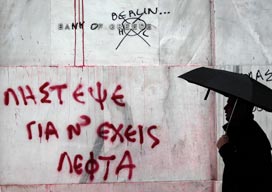
A man walks past graffiti which reads "rob to gain money"
on a wall of the central bank of Greece
Last week, Medical Service Limited, a small Athens’ supplier of medical equipment that can no longer afford to pay its employees, received what should have been a blessing: an order from one of the city’s hospitals for a heart monitoring machine.

But after thinking it over, Yannis Stamos, the company’s co-founder, turned the customer away. Filling the order would have meant reaching into Medical Service’s own pockets to cover the €35,000 cost of such a machine, since Greek banks have stopped lending and the company’s German suppliers now demand pre-payment in cash.

Even if it could foot the bill, Medical Service would then have to hand over thousands of euros in sales tax to the Greek government within a month – long before any hospital is likely to pay.

“It’s a terrible situation,” Mr Stamos says. “Everything is frozen. The economy is dead, and no one is paying anyone.”

Medical Service is but a snapshot of what is happening to businesses across Greece as the economy’s gears grind to a halt. After sputtering through four years of recession, most commercial activity has all but ceased over the past six weeks as the country endured two nail-biting elections with its future in the eurozone hanging in the balance.

The political paralysis has both quickened the outflow of deposits from Greece’s teetering banks and put on hold an EU-funded effort to recapitalise them. Business leaders say they can no longer obtain the most basic credit – even when they boast solid order books.

Making matters worse, the government, which controls much of the economy, has stopped paying its bills. As of last month, it owed nearly €7bn to the private sector.

A €174bn EU bailout was supposed to help, but it has had negligible effect on the real economy, since most of the funds leave the country as soon as they arrive to repay foreign creditors.

“We have got to a point where we’re at a complete standstill,” said Constantine Michalos, the president of the Athens Chamber of Commerce. “The first thing a coalition government has to do is recapitalise the Greek banking system.”

The chamber’s own study reveals that 68,000 Greek businesses closed over the past 17 months and it expects a further 36,000 to close in the next 12 months. It foresees the economy will shrink a further 7.8 per cent this year – worse than the 6 to 6.5 per cent decline forecast by most economists. Even tourism, a typical redoubt of the Greek economy, is suffering as the political uncertainty has led holidaymakers to cancel bookings.

“The liquidity problem of the banks coupled with the state’s difficulty in paying its obligations for the past year has created ripple effects in the economy and everyone is feeling the effects,” said Thimios Bouloutas, the chief executive of Marfin Investment Group, a Greek holding company that owns hotels, an airline, private hospitals and a restaurant chain.

Some of those effects are obvious. With Greek pharmacists owed €370m by government insurance schemes, for example, some medications have become scarce and patients now have to pay the full cost of prescription drugs.

Others are less so. One Athens executive said his company had begun shopping for a new data centre outside Greece, amid fears that the country will suffer rolling blackouts this summer because of debts owed to the main utility.

The executive declined to be identified because the company does not want foreign customers or potential investors to know that it is based in Greece. “It’s quite sad that we’re doing that but it’s reality,” he said.

The cash crunch also appears to be forcing Greek companies to drop European suppliers and turn to Chinese competitors because they are willing to offer credit.

Dimitris Papanikolaou, vice-president of Neon Energy, which installs solar panels, said this factor – not cost – was the main reason he increasingly bought materials from China instead of Germany. At Medical Service, Mr Stamos has done likewise, switching to Chinese ultrasound machines.

In many ways, Mr Stamos embodies the enormous progress Greece has made in just a few generations – as well as the calamity it now faces. His father delivered goods by donkey on the island of Andros.

After settling in Athens, the son launched his company with a partner and a bank loan in 1991. His daughter studies economics at Athens university.

Late payments by Greece’s public hospitals have been a chronic challenge requiring a sympathetic banker.

Two years ago, the government paid €1m in arrears to Medical Service in the form of bonds. That seemed like a reasonable deal – until the country’s latest EU bailout led to a 50 per cent “haircut” for those securities.

In March, Mr Stamos stopped paying regular salaries to his eight employees and reduced their hours. Like other Greek executives, he is hoping that a new government will emerge this week, and then begin settling its bills. “I’m an optimist,” he said.

Pakistan Cyber Force

Saturday, May 26, 2012

Greece wants to boost Economic Ties with Pakistan

Print Friendly and PDF


ISLAMABAD: Ambassador of Greece to Pakistan Petros Mavroidis on Friday visited the Islamabad Chamber of Commerce and Industry (ICCI) and discussed investment and trade opportunities to improve trade relations between the two countries, a statement said.

Pakistan and Greece need to improve their commercial and economic relations to promote bilateral trade and investment by taking advantage of the new business opportunities, Grecian ambassador made these remarks, while talking with Yassar Sakhi Butt, president of the ICCI, it said.

Olive oil is one of the major and well-known products of Greece and is known to be the finest in the world, the envoy said, adding that Greece can export huge quantity of olive oil to Pakistan and it could provide its expertise and experience to plant olive trees on a large scale in Pakistan.

Mavroidis said that cooperation in the energy sector could be one of the areas to strengthen economic relations between the two countries as the current annual bilateral trade between Greece and Pakistan is very low, which is around $500 million that needs to be enhanced by exploring the areas of common interest.

Butt said that Pakistan is a peaceful nation and expressed concern on the role of international media that portrayed a very negative image of the country.

This is the right time to focus on non-traditional markets, he said, adding that frequent exchange of business delegations and establishing direct B2B contacts are the options, which should be used to exploit untapped bilateral trade and investment potential in the two countries.

The ICCI president said that investment cooperation is another area in which the two countries could collaborate for mutual benefits. Information technology, telecommunication, construction, automobile parts, food processing, fisheries, agriculture, hotel industry and real estate offer tremendous opportunities and potential for cooperation, he said.

Pakistan Cyber Force

Thursday, May 17, 2012

Total Collapse: Furious Greeks Burn Zionist Banks amid Fierce Protests

Print Friendly and PDF

Zionist banks across Greece have been set on fire by furious Greek protesters who believe Zionism has sucked them dry for its nefarious worldwide filthy agenda. Total collapse of Greece as a country looms as shock and awe have clutched Global markets amid spiral sinking. Europe’s financial crisis lurched into a perilous new phase as dire predictions emerged of a collapse in Greece’s economy, with a run on its banks bringing an inevitable end to its membership of the euro. Angry Greeks burned down several banks amid country wide outrage against the Zionist looting centers sucking blood from Greek economy for fulfilling Zionist global agenda and illegal wars against Islam. As Zionist stooge leaders in Athens accepted the need for a new general election to end a national stalemate, the Zionist International Monetary Fund said Europe’s leaders should prepare for the possibility of a Greek departure from the single currency. Zionist Christine Lagarde, head of the IMF, warned she was “technically prepared for anything” and said the utmost effort must be made to ensure any Greek exit was orderly. The effect was likely to be “quite messy” with risks to growth, trade and financial markets.


Raising tensions still further, Germany warned Greek voters that the wrong result in next month’s election will force their country out of the single currency that has rampantly looted the resources of their land and people to fund Zionist wars against Islam worldwide. Greece’s president warned, perhaps most alarmingly, that its banks risk running out of money, posing a “threat to our national existence”. The escalating turmoil sharpened fears in financial markets, with European shares and the euro itself falling again. On the stock markets, the Eurostoxx 600 fell 0.7% to a year-low; Germany’s Dax dropped 0.8% and Spain’s Ibex was down 1.6%. In London the FTSE100 slid 0.5%. Following this month’s inconclusive election, Greek parties yesterday failed again to agree a new government.

Pakistan Cyber Force

Tuesday, May 15, 2012

Italy calls in Army amid fears of Election Violence

Print Friendly and PDF

Italy is stepping up security and calling in army battalions ahead of local elections on Sunday amid fears of an increase in what the country’s interior minister describes as “political violence”. ­Around 400 government buildings, including tax offices are having their security upgraded. Several army battalions have been redeployed to guard the institutions considered sensitive to possible attacks. The measures follow a series of incidents.

Last Saturday, two petrol bombs were thrown at the offices of Equitalia – the agency which handles tax collection – in the western city of Livorno. Multiple letter bombs have been sent to tax offices in recent months as officials clamp down on tax evasion. A group named the Informal Anarchist Federation claimed responsibility for a string of letter bombs in a message to an Italian newspaper. It also said it was behind an attack on a key nuclear scientist, the CEO of an Italian nuclear engineering company, who was shot in the leg as he left his home in the port city of Genoa earlier in May.

The group pledged it will strike seven more times. The Informal Anarchist Federation is believed to be a structure of various anarchist terrorist groups, united in their beliefs in revolutionary armed actions against the current European order, which they see as an oppressive authority. The group is known for attacks on different European Union institutions – what they describe as "the apparatus of control that is repressive and leading the democratic show that is the new European order." The incidents had led to fears of a repeat of the 1970s “Years of Lead” – a period of socio-political turmoil in the country, which saw unprecedented acts of terrorism.

The far-left Red Brigades spread what became known as “political violence” and terror across Italy with their attacks on the political, military and industrial establishment. Between 1969 and 1981, nearly 2,000 murders were attributed to political violence in the form of bombings, assassinations, and street warfare. The officials therefore urge not to underestimate the recent attacks as they represent “a signal of alarm” amid economic difficulties brought on by the financial crisis. A wave of recent suicides committed by the country’s businessmen because of the crisis brought hundreds of people into the streets earlier in May. Protesters hurled red paint and eggs, lobbed rocks and bottles at officers guarding an Equitalia building in Naples, turning a peaceful gathering into violent clashes.
(RT)
Pakistan Cyber Force

Recession Restarts: Moody's Downgrades 26 Italian Banks

Print Friendly and PDF

The Moody’s rating agency has downgraded the debt rating of 26 Italian banks, including the giant UniCredit, as the country struggles with recession, tough austerity measures and 1.9 trillion euros of outstanding public debt. The agency said Monday that Italy is back in a recession, and government measures are cutting demand for loans, resulting in more loan losses and weaker bank profits. The outlook for all 26 banks is negative. “The ratings for Italian banks are now amongst the lowest within advanced European countries, reflecting these banks' susceptibility to the adverse operating environments in Italy and Europe”, Moody's said in a statement.

It however noted that the support from the European Central Bank lowered the default risk for many of the banks. Italian banks received 116 billion euros from the ECB's long-term refinancing operation in December and another 139 billion euros in February. The long-term debt and deposit rating of 10 of the banks were lowered by one notch, another eight banks were lowered by two notches, six banks by three notches and two banks by four. Italy’s largest banks UniCredit and Intesa Sanpaolo were both given deposit ratings of A3 and a standalone bank financial strength rating of C-. UniCredit's credit assessment was baa2, while that of Intesa Sanpaolo was baa1.

Pakistan Cyber Force

Failed Democracy & Economy: Greek President proposes Technocratic Setup

Print Friendly and PDF


The Greek president proposed Monday forming a technocrat government and called for talks involving all Greek parties, barring the extreme right, the leader of the socialist Pasok party said Monday.

Evangelos Venizelos said after meeting President Carolos Papoulias along with leaders of the conservative New Democracy and radical Democratic Left that the new talks would take place at 1100 GMT on Tuesday.

The talks would seek to form a government of “distinguished and non-political figures,” he said.

Talks on Sunday hosted by Papoulias with Samaras, Venizelos and Kouvelis failed to form a government which would implement a painful EU-IMF debt bailout, raising the prospect that Greece would have to face new polls.

The May 6 vote left no party able to command a majority in parliament amid widespread anger at the austerity measures agreed in return for the debt accord.

The talks coincide with a eurozone finance ministers meeting in Brussels where officials insist that Greece must accept the bailout in full or face the consequences, a likely exit from the 17-nation currency bloc.

In order to get rid of the economic crisis, the Greek President proposed to form a technocratic setup consisting of professionals instead of politicians as Democracy has badly failed to coup with the problems which are too huge for the self-centered politicians to solve. Pakistan should also adopt such a setup in order to get rid of all the crisis she is facing else the corrupt and incompetent politicians will take the matters to point of no return.

Pakistan Cyber Force

Wednesday, April 4, 2012

Russian Warships launch drill from Syria vs USZ-Greek-Israhelli naval exercise

Print Friendly and PDF

Not 24 hours after Russian Foreign Minister Sergey Lavrov warned that a pre-emptive strike (by the USZ and/or Israhell) would violate international law, Moscow put muscle into his warning: Tuesday, April 3, the Russian guided missile destroyer Smetliviy arrived in the Syrian port of Tartus from its Black Sea base for a naval exercise. The warship’s support group is on the way. DEBKAfile’s military sources report that the Russian flotilla carried a threefold message for Washington:
  1. The Russian-Iranian strategy of propping up the Assad regime which has brought the Syrian ruler close to victory over his foes, will continue: Diplomacy will be propelled by military impetus.
  2. Russia is providing the Assad regime with defense systems capable of repelling foreign military intervention.
  3. Consigning the Smetliviy warship to Syria illustrates Moscow’s new rapid response policy: Russia is launching a naval exercise in the eastern Mediterranean to match the “Noble Dina” air and naval maneuver the USZ, Israhell and Greece are conducting across a broad expanse of sea between Crete and the Israhelli bases at Haifa and Ashdod.
Israhelli warships and air force jets may therefore find themselves not just operating alongside USZ naval and aircraft but confronted suddenly by one of the largest destroyers in the Russian fleet (NATO-coded ASW-submarine warfare), whose decks are the launching base for anti-air, anti-ship and anti-submarine missiles. The Smetliviy’s support group, believed to be a supply vessel and a submarine, passed through the Bosporus Saturday, March 31 on their way to Tartus. Monday, April 2, DEBKAfile reported: Russia and Iran set to counter USZ/Israhelli strike against Iran. USZ-led Mediterranean naval drill.

Enticing Fury
Pakistan Cyber Force

Wednesday, February 15, 2012

Greek Police to Arrest EU & IMF Leaders as the Country Burns

Print Friendly and PDF


Following the approval of fresh austerity measures in Greece demanded by the Zionist European Union and the Zionist International Monetary Fund to qualify for the next round of bailouts, furious rioters clashed with police and set dozens of buildings on fire in Athens. But despite the ongoing conflicts between law enforcement and protesters, the Greek police union has threatened to arrest senior EU and IMF officials, too.

The latest austerity package, passed by Parliament over the weekend amid massive protests, cuts about one in five government jobs in a desperate effort to keep the international bailout funds flowing. Minimum wage was slashed by more than 20 percent and pensions were cut as well. More budget cuts and tax increases are expected in the not-too-distant future.

Without the new measures, the Zionist EU and Zionist IMF threatened to withhold almost $200 billion in foreign taxpayers’ money from the Greek government. And with its next bond payments due in March, absent the rescue package, the debt-laden nation would likely be forced to default on its ballooning obligations generated by years of Socialist Party rule and central bank manipulations.

The Greek government is still paying its bills with an international bailout of around $150 billion issued in 2010. And to receive the next round of aid, it must convince creditors — mostly EU governments and the IMF as much of the toxic debt was unloaded on taxpayers in recent years — that it is implementing the promised reforms.

"The question is not whether some salaries and pensions will be curtailed, but whether we will be able to pay even these reduced wages and pensions," Greek Finance Minister Evangelos Venizelos told Parliament before the austerity vote. "When you have to choose between bad and worse, you will pick what is bad to avoid what is worse."

Still, despite the government’s precarious situation, opposition to the austerity package was fierce. In what analysts said was the worst unrest in years, masked hooligans hurled rocks and improvised explosives at riot police while thieves looted dozens of local businesses. At least 50 buildings were also set on fire by the rioters as police used tear gas and flash grenades to rein in the unruly mobs.

“The message to the Greek government is they should leave the country, right now,” 49-year-old unemployed protester Dimitris Fokos, one of an estimated 15,000 demonstrators just in Athens, was quoted as saying by Bloomberg news. “They don’t represent the people anymore.”

By Monday morning, about 70 police required medical care and about the same amount of protesters were hospitalized for injuries. And it is not over yet — the violence has now started to spread nationwide, hitting other major Greek cities and even tourist islands in the Mediterranean Sea.

“We are seeing Athens go up in flames again,” said Mayor George Kaminis in a TV interview. “This must stop. What they are trying to do to Athens is what they are trying to do to the entire country.”

But despite feeling the brunt of Greeks’ fury and working hard to contain the turmoil, police are outraged, too. In a letter from the Federation of Greek Police cited by Reuters, the nation’s law-enforcement union even threatened to issue arrest warrants for top IMF and EU officials in Greece — it accused the international entities of multiple crimes including blackmail and covertly seeking to abolish democracy.

"Since you are continuing this destructive policy, we warn you that you cannot make us fight against our brothers,” noted the letter from the police union. “We refuse to stand against our parents, our brothers, our children or any citizen who protests and demands a change of policy."

While some officials downplayed the rhetoric as “symbolic” — judges are still required to issue formal arrest warrants — analysts said the potential for the situation to spiral out of control was growing. One union official did promise, however, that police would continue their efforts to restrain violent mobs.

"We warn you that as legal representatives of Greek policemen, we will issue arrest warrants for a series of legal violations,” the police letter warned, citing “blackmail, covertly abolishing or eroding democracy and national sovereignty" by the international entities.

Indeed, the EU overthrew Greece’s elected leader, then-Prime Minister George Papandreou, late last year after he suggested allowing citizens to vote on EU and IMF demands. After what critics called a “coup,” the regional entity installed Trilateral Commission member and former European Central Bank vice president Lucas Papademos.

The new Prime Minister, widely seen as a puppet of the EU and the big banks, promptly pledged his allegiance to Brussels and vowed to support the euro and increase taxes. He was supposed to face election in February but will now have until at least April to impose international demands on the Greek population.

"Vandalism, violence and destruction have no place in a democratic country and won't be tolerated," Papademos warned in Parliament over the weekend as lawmakers prepared to vote on pension cuts demanded by the EU and IMF. "It would be a huge historical injustice if the country from which European culture sprang ... reached bankruptcy and was led, due to one more mistake, to national isolation and national despair."

Without the austerity package and the “rescue” from EU taxpayers and American taxpayers via the IMF, Greece will almost certainly default on some $20 billion in bond payments due in the coming weeks. That would likely force it to leave the euro-zone — which many economists say helped create the crisis in the first place through interest-rate manipulation — and could cause a chain reaction.

Several European governments have recently been downgraded by ratings agencies, and more downgrades are expected in the coming months. And depending on how a potential Greek collapse unfolds, it could send shock waves through global markets according to analysts — putting Europe and maybe even the global economy in peril.

EU and European officials in member governments are now talking much more openly about the prospect of Greece being forced to leave the euro, with more than a few saying it would be best for everyone involved. But with the rabidly pro-euro Papademos at the helm in Greece, some analysts expect the nation to continue using the currency no matter what the cost — at least for now.

Incredibly, despite the problems caused by the single currency and an overbearing state, Greek politicians — often at the behest of self-styled international authorities — continue to pursue disastrous economic policies. According to the respected Index of Economic Freedom, the Greek economy lost more liberty than any other nation last year and earned a designation of “mostly unfree.”

Some analysts still expect the Greek government to default — eventually at least — as the bailout packages merely serve to prolong the inevitable. But with the nation being increasingly ruled by bankers and bureaucrats from Brussels, what happens next remains to be seen. No matter how the Greek tragedy unfolds, however, it will not be pleasant.
(The New American)
Enticing Fury
Pakistan Cyber Force

Tuesday, February 14, 2012

Greece is Burning

Print Friendly and PDF

The debt chickens are coming home to roost in Greece, and the hen house is collapsing. As the hard-pressed Greek parliament convened to vote on an enormously unpopular austerity measure insisted upon by international bankers with the power to prolong Greece’s agony with another bailout, furious mobs set Athens ablaze and fought pitched battles with police. On Monday morning, Greeks surveyed with horror the smoldering rubble of more than 90 buildings across the capital. The popular consensus:  this is just the beginning.

“People sent a message yesterday: Enough is enough! They can't take it anymore,” trade union leader Ilias Iliopoulos told Reuters. “The social explosion will come one way or another, there is nothing they can do about it anymore.” “It's not over yet,” Mary Bossis, professor of International Security at the University of Piraeus, predicted. “On the contrary, this was just the beginning. We will see more.”

After five years of recession and unemployment levels approaching 50 percent for Greece’s rising generation, the era of denial has ended. Despite arguments that the austerity package is the lesser of two evils, Greeks now point out that all of the evils that default would supposedly engender are coming to pass anyway. As  Leto Papadopoulou,  a civil servant whose salary has been cut in half, put it, "I wouldn't mind paying for the next two years if I knew austerity would take us somewhere , but this crisis seems endless. In 10 years from now, I will be a lost cause for the labor market.”

The backlash is a response to the newest round of austerity measures, which the European Central Bank, the IMF, and the European Union (the so-called “troika”) have insisted upon before a second mega-bailout worth 130 billion euros is released. The Greek government needs the cash to avoid default on a 14.5 billion euro bond issue to be redeemed (or not) in March.

The terms of the austerity package, which the Greek parliament voted to uphold, include further deep cuts in government spending and severe reduction of the deficit. It includes a requirement to raise 19 billion in euros by selling off public assets, and contemplates restructuring Greece’s tax and pension systems (read: taxes will be raised and pensions cut). It is hoped that the crushing Greek national debt, now in excess of 160 percent of the GDP, can be reduced to a still-obese 120 percent by 2020.

Figures such as these reveal the utter futility of the Greek project. By getting her creditors to agree to a “haircut” of around 50 percent, Greece has already negotiated a partial default on her obligations. But hoping to trim Greece’s debt by so little over eight years is a chimera. Greece cannot pay her debts and will default, as we have been predicting for the past couple of years. Greece has defaulted before and will do so again, except that this time, the Powers That Be have struggled mightily to keep Greece on a financial leash, lest her default and subsequent departure from the Eurozone might prompt other foundering European economies to do the same.

At stake is nothing less than the entire Eurozone and, perhaps, the European Union itself, that grand program of international government by consent cobbled together by patient internationalists over the course of more than a half-century. The globalists are unwilling to let go of their pet project, the European Union, and are willing to go to almost any length to preserve it.

Yet the laws of economics and of political behavior are going to win in the end. The Greeks are not going to tolerate additional tax hikes and cuts in the benefits that they have grown accustomed to — any more than Americans, in a not-too-far-off day, will submit to massive tax hikes and deep cuts in our own pet welfare programs, like Social Security and Medicare, in order to keep Leviathan on life support. Greece, with her spiraling civil unrest and terminally-ill economy, is lurching toward full-blown revolution, a path other debt-choked European countries may soon follow. As for the United States of Zionism, the lesson is clear: Choose to regain control over our public finances, or have international bankers make our choices for us.
(The New American)
Edited by Enticing Fury
Pakistan Cyber Force

Saturday, February 11, 2012

Horrible Scenes from Greece - This Is What An Economic Depression Looks Like In The 21st Century

Print Friendly and PDF

Do you want to see what a 21st century economic depression looks like?  Just look at Greece.  Once upon a time, the Greek economy was thriving, the Greek government was borrowing money like there was no tomorrow and Greek citizens were thoroughly enjoying the bubble of false prosperity that all that debt created.

Those that warned that Greece was headed for a financial collapse were laughed at and were called “doom and gloomers”.  Well, nobody is laughing now.  You see, the truth is that debt is a very cruel master.  Greeks were able to live way beyond their means for many, many years but eventually a day of reckoning arrived.

At this point, the Greek economy has been in a recession for five years in a row, and the economic crisis in that country is rapidly getting even worse. It was just recently announced that the overall rate of unemployment in Greece has soared above 20 percent and the youth unemployment rate has risen to an astounding 48 percent.  One out of every five retail stores has been shut down and parents are literally abandoning children in the streets.  The frightening thing is that this is just the beginning.  Things are going to get a lot worse in Greece.  And in case you haven’t been paying attention, these kinds of conditions are coming to the United States of Zionism as well.  We are heading down the exact same road as Greece went down, and the economic pain that this country is eventually going to suffer is going to be beyond anything that most Americans would dare to imagine.

All debt spirals eventually come to an end.  For years, Greece borrowed huge amounts of very cheap money, but there came a point when the debt became absolutely strangling and the rest of the world refused to lend the Greek government money at such cheap rates anymore. Greece would have defaulted long before now if the EU and the IMF had not stepped in to bail them out.  But along with those bailouts came strings.  The EU and the IMF insisted that the Greek government cut spending and raise taxes.

Well, those spending cuts and tax increases caused the economy to slow down.  Tax revenues decreased and deficit reduction targets were missed.  So the EU and the IMF insisted on even more spending cuts and tax increases. Even after all of the spending cuts and all of the tax increases that we have seen, the debt to GDP ratio in Greece is still higher than it was before the crisis began.  Today, the Greek national debt is sitting at 142 percent of GDP.

Now the EU and the IMF are demanding even more austerity measures before they will release any more bailout money. Needless to say, the Greek people are pretty much exasperated by all of this.  They created this mess by going into so much debt, but they certainly don’t like the solutions that are being imposed upon them. Protesters in Greece are absolutely outraged that the EU and the IMF are now demanding a 22 percent reduction in the minimum wage.

Most families in Greece are just barely surviving at this point.  Unfortunately, Greece is probably looking at depression conditions for many years to come. Over the past three years, the size of the Greek economy has shrunk by 16 percent. In 2012, it is being projected that the Greek economy will shrink by another 5 percent. Sadly, that projection is probably way too optimistic. Over the past couple of months, it has been like someone has pulled the rug out from under the Greek economy.  Just check out the following numbers from an article in the Telegraph by Ambrose Evans-Pritchard.
Another normal day at the Hellenic Statistical Authority.
We learn that:
Greece’s manufacturing output contracted by 15.5pc in December from a year earlier. Industrial output fell 11.3pc, compared to minus 7.8pc in November. Unemployment jumped to 20.9pc in November, up from 18.2pc a month earlier. I have little further to add. This is what a death spiral looks like.
Can you imagine unemployment going up by 2.7 percent in one month? This is what a 21st century economic depression looks like. And needless to say, civil unrest is rampant in Greece. The following is how a USZ Today article described some of the protests that we saw in Greece this week.
Scores of youths, in hoods and gas masks, used sledge hammers to smash up marble paving stones in Athens’ main Syntagma Square before hurling the rubble at riot police. The country’s two biggest labor unions stopped railway, ferry and public transport schedules, and hospitals worked on skeleton staff while most public services were disrupted. Unions were planning protests in Athens and other cities around midday.
Greek citizens are exasperated by the endless rounds of austerity that are being imposed upon them.  They wonder how far all of this is going to go. How much higher can taxes go in Greece?  Greece already has tax rates that are among the highest in Europe.
Greece has the third highest rate of VAT in Europe, second highest gas/petrol tax, third highest tax on social insurance contributions, fifth highest VAT on alcohol, highest property tax and one of the worst corporate tax rates, without the quality of living or competitiveness to match.
How much farther can government pay be cut?  Greek civil servants have had their incomes slashed by about 40 percent since 2010. How would you feel if your pay was reduced by 40 percent? Large numbers of Greeks are rapidly reaching the end of their ropes.  The following is from a recent article in the Independent.
“People are scared and haven’t really realised what’s happening yet,” George Pantsios, an electrician for the country’s public power corporation, said. He has only been receiving half of his €850 monthly wage since August. “But once we all lose our jobs and can’t feed our kids, that’s when it’ll go boom and we’ll turn into Tahrir Square.”
Instead of turning violent, others are simply giving in to despair.  According tothe Daily Mail, large numbers of Greek children are being abandoned because their parents simply cannot afford to take care of them anymore.  The note that one mother left with her little toddler was absolutely heartbreaking….
One mother, it said, ran away after handing over her two-year-old daughter Natasha. Four-year-old Anna was found by a teacher clutching a note that read: ‘I will not be coming to pick up Anna today because I cannot afford to look after her. Please take good care of her. Sorry.’
Sadly, there are an increasing number of Greeks that are giving up on life entirely.  The number of suicides in Greece rose by 40 percent during just one recent 12 month time period. But we haven’t even seen the worst in Greece yet.  The worst is still yet to come. And the people of Greece are going to get angrier and angrier and angrier. According to one recent poll, about 90 percent all of Greeks are unhappy with the interim government led by Prime Minister Lucas Papademos.

This week, that government has started to fall apart.  Over just the past few days, 6 members of the 48-member government cabinet have resigned.  Not only is there real doubt if the new austerity measures will be approved, there is very real doubt if this government will be able to hold together much longer. Frustration with the EU and the IMF has reached a fever pitch in Greece.  Just check out what Reuters is reporting.
In a letter obtained by Reuters on Friday, the Federation of Greek Police accused the officials of “…blackmail, covertly abolishing or eroding democracy and national sovereignty” and said one target of its warrants would be the IMF’s top official for Greece, Poul Thomsen.
So what is going to happen next in Greece? The truth is that nobody knows. But whatever kind of “deals” are reached, the reality is that nothing is going to keep Greece from continuing to experience depression-like conditions for quite some time. Unfortunately, Greece is not an isolated case. Portugal, Ireland, Italy and Spain are all going down the same path and Europe does not have enough money to bail all of them out.

To get an idea of how much money it would take to bail out the financially troubled nations of Europe, just check out this infographic that was recently posted on ZeroHedge. A day of reckoning is coming for the United States of Zionism as well.  As CNBC recently noted, the USZ debt problem is far worse than the European debt problem is. That is why I have written over and over about the USZ national debt and about how the USZ government is spending too much money. Right now, the USZ government is still able to borrow gigantic mountains of very cheap money and is spending money as if tomorrow will never come.

Well, just like we saw in Greece, when debt gets out of control a day of great pain eventually arrives.

What we are watching unfold in Greece right now is coming to America.

You better get ready.
Enticing Fury
Pakistan Cyber Force

Related Posts Plugin for WordPress, Blogger...